Welcome to the fourth part of the second chapter of the story of the ‘Beefing’ group of apples. In this instalment I’ll be looking at the central role played by Dr Robert Hogg and Dr Henry Graves Bull in the (re?)discovery of ‘Herefordshire Beefing’.
Please note: this is one part of one chapter of a much longer series of articles exploring the story of Norfolk Biffins and ‘Beefing’ Apples. Please see the main Table of Contents page for links to the other chapters in this story.
In This Part of Chapter Two
Dr Hogg, Dr Bull and the Origins of ‘Herefordshire Beefing’
– Introducing Dr Bull and The Herefordshire Pomona
— Dr Hogg Meets the Woolhopians
– A New ‘Beefing is (Re?)Discovered
— ‘Herefordshire Beefing’ is “Described and Figured for the First Time”
– Detailed Discrepancies and Additional Oddities
— Descriptive Divergences
— Seeking the Stroud List
— Hogg’s Oddities
— Et Tu, A.F.B.?
– Cranston’s Nursery and the “New” ‘Herefordshire Beefing’
— Passing Off, Sir? The Very Idea!
— Cranston’s Goes Marching On
– Herefordshire Biffins?
– Was ‘Herefordshire Beefing’ New or Not?
— Who Brought the ‘Beefing’ to the Meeting?
— Cranston’s Beefing?
— Bull’s Beefing?
— Bulmer’s Beefing?
— Herbert’s Beefing?
– Summary and Conclusions
— A Likely Story?
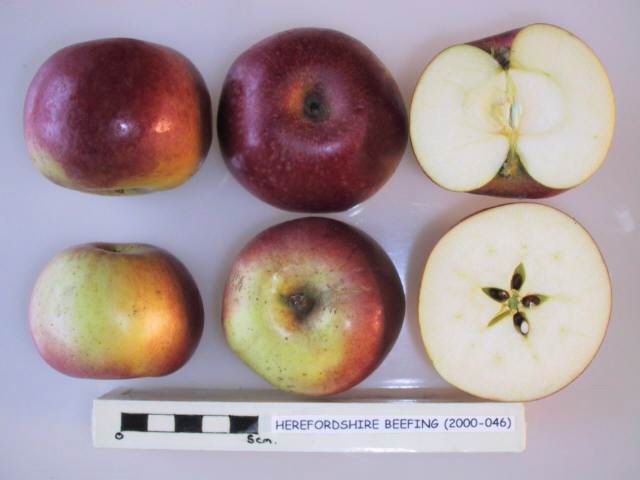
So far in chapter two of the ‘Beefing’ Apples Story I’ve discussed the key role played by the eminent Victorian pomologist Dr Robert Hogg in the stories of two of the ‘Beefing’ group of apples: ‘Norfolk Beefing‘, and ‘Striped Beefing‘. In this episode, I’ll be talking about how Hogg, along with Dr Henry Graves Bull, had an even greater involvement in the origin story of a third ‘Beefing’ apple: ‘Herefordshire Beefing’.
When I started looking into the origins of ‘Herefordshire Beefing’ I thought I would be telling a relatively straightforward tale of the discovery and naming of a ‘Beefing’-type seedling apple. Of course, it wasn’t long before I found a loose thread to pull on, then another, and then another… until eventually the full story turned out to be much, much more complex and intriguing than I had originally anticipated. Which is why this part of the ‘Beefing’ apples story is … well, it’s really quite a long one.
If you’re only interested in the facts of the case and my own, best-guess interpretation of the events surrounding the introduction of ‘Herefordshire Beefing’ in the 1870s and 1880s, feel free to skip ahead to the Summary and Conclusions section for a timeline of the factual material I’ve come across, and my own best-guess version of the ‘Herefordshire Beefing’ origin story. On the other hand, if you have the time1I’d say a good hour or two. You might want to put the kettle on… and inclination for the full story, then do read on.
I’ll begin by introducing the greatly admired Dr Henry Graves Bull and the immense amount of work that he, and others, as we shall see, put into the absolute pinnacle of Victorian-era pomology that is The Herefordshire Pomona.
Introducing Dr Bull and The Herefordshire Pomona

Dr Henry Graves Bull was born in Northamptonshire, trained in medicine at Edinburgh and Paris, and relocated to Hereford in 1841, where he became a hugely popular and greatly respected2Dr Bull’s obituary in the British Medical Journal described him as “an able medical practitioner and an admirable citizen, whose loss in public and social life will be long felt”, and he was much missed by his friends and colleagues in the Woolhope Naturalists Field Club, as the deeply moving ‘In Memoriam’ item at the end of the Transactions of the Woolhope Naturalists Field Club for 1885 clearly shows. figure in his adoptive city. For forty-four years Bull worked tirelessly at the Hereford Dispensary and General Infirmary. He was also a board member and trustee of numerous philanthropic societies, served as a Justice of the Peace, and was a founder member of the British Mycological Society.
Dr Bull also became one of the key figures in Victorian-era pomology when, between 1878 and 1885, he compiled and edited the truly magnificent work that is The Herefordshire Pomona.3For more on the creation of The Herefordshire Pomona, and the social context in which it was produced, I can highly recommend Bill Laws’ superb book The Story of the Herefordshire Pomona (Logaston Press, 2025), which I reviewed in October 2025. There’s also an introduction to some of the key characters involved, in the article ‘When Doctor Hogg Went to Hereford’ on applesandpeople.org.uk. Six hundred copies of this superb blend of fine art and pomological knowledge were originally published. The full work was released in seven parts, which were issued to subscribers on an annual basis. A two-volume collected edition was also published in 18854Bill Laws, The Story of the Herefordshire Pomona (2025), p. 2. which didn’t take long to become a valuable collectors’ item5In 1897 bookseller Bernard Quaritch offered the two volume edition for sale at £15 15s, around £1,800 today., and of course it is even rarer and more precious today.6A first edition of The Herefordshire Pomona was sold at auction by Bonhams in 2022 for £4,845.
Dr Bull did not carry out this nine year labour of pomological love in isolation, having secured:
“[the] gratuitous7Gratuitous is used here in the sense of “free of charge” rather than “unnecessary or uncalled for”. assistance of the learned pomologist, Dr. Hogg — a man of European reputation — who, in accepting the position of Technical Editor, gave a guarantee to the scientific correctness of the Pomona. Dr. Hogg met the wishes of the Committee in a cordial and generous spirit, and placed the stores of his knowledge — the fruits of life-long study — entirely at its disposal. To him, therefore, the Woolhope Club has the pleasure of offering its best and most grateful thanks.”8The Herefordshire Pomona vol 1 (1885), General Introduction, page II.
Even more crucially, The Herefordshire Pomona ‘s success relied on the highly skilled artistic input – in the form of the vast majority of the many beautiful illustrations of the apple varieties described in The Herefordshire Pomona – that was provided over hundreds of hours of work by the botanical artists Alice Blanche Ellis and Edith Elizabeth Bull, the latter of whom was Henry’s daughter. One illustration was contributed9The Herefordshire Pomona vol 1 (1885), General Introduction, page III. by Frances Stackhouse Acton, of Acton Scott in Salop, the daughter of the renowned pomologist Thomas Andrew Knight, and one more was provided by noted botanist and botanical artist Worthington George Smith. The artists involved were warmly praised and thanked for their work,10See The Herefordshire Pomona vol 1, general introduction page II for an example. and in 1885, following a subscription drive led by Lady Emily Foley of Stoke Edith House, a sum of 100 Guineas was paid to both Ms. Ellis and Ms. Bull, in recognition of:
“… their eminent services in the production of a book which has justly been styled by the distinguished Pomologist, Robert Hogg, Esq., L.L.D., F.L.S., London, “the most splendid work in artistic execution, and fidelity in design, which has ever been produced on the subject.””11Transactions of the Woolhope Naturalists Field Club 1886-87-88-89, p. 19

The Herefordshire Pomona project was an expensive one to undertake, mainly due to the cost of producing the coloured plates for the illustrations. A full financial statement for the Herefordshire Pomona project was published in 188512Transactions of the Woolhope Naturalists field Club 1883-4-5 p. 273-275, and showed an overall shortfall of £349 17s 3d; approximately £40,000 today13Estimate provided by the Bank of England Inflation Calculator..
As well as the two-volume collected edition, a follow-up, The Apple and Pear as Vintage Fruits, was published in 1886 and focused on the Herefordshire-grown varieties of those fruits deemed most suitable for making cider and perry. The introduction to the new volume made clear that it was not just a re-working, or spin-off from the main work:
“It is not a mere reprint of the Herefordshire Pomona ; for much additional knowledge was obtained, and the papers were re-written for this book, that it might be specially valuable to the fruit growers and cider makers of the county.”14The Apple and Pear as Vintage Fruits (1886), preface p. IX
The ambitious, years-long, and hugely impressive Herefordshire Pomona project was carried out not as the result of some government-led initiative, or at the behest of a publishing company of the day. Instead, it was the result of the pomological activities of a Herefordshire-based society of nature enthusiasts and local historians called the Woolhope Naturalists Field Club, of which Dr Bull was a prominent and inspirational member, and an invitation that the Club extended to one of the most prominent pomologists in Europe.
Dr Hogg Meets the Woolhopians
The Woolhope Club was, in Dr Bull’s day, a society of gentleman15Ladies, often the wives and daughters of the regular members, were invited to one field trip per year, as is evidenced by various editions of the Transactions. naturalists who spent several weekends per year engaged in the study of the history, geology, meteorology, flora, fauna and mycology of Herefordshire and its neighbouring counties. Bull was a regular speaker at the Woolhope Club’s dinners, wrote many articles for the Club’s Transactions, and served a single term as President in the 1860s. He was also a keen apple grower who was instrumental in establishing the Club’s annual apple and pear shows, and at which he regularly exhibited his choicest varieties.
The Woolhope Club’s first apple and pear show was held at the Free Library in Hereford on October 14th 1875, following the annual “Fungus Foray” field trip, and a hearty dinner at the Green Dragon Hotel. It was in the wake of this first show that the Woolhopians took up the pomological gauntlet with their typical gusto, by declaring a new mission for themselves: to revitalise Herefordshire’s neglected orchards and, by extension, the county’s cider industry, as subsequently recorded in the Club’s Transactions for 1875:
“One object of the Club will henceforth be to ascertain the correct names of the different kinds of cider, perry, cooking and dessert apples and pears, produced in this and the neighbouring districts ; to determine the best sorts grown ; and so to be able to recommend the cultivation of fruits of greater excellence in the place of existing kinds of an inferior quality.”16Transactions of the Woolhope Naturalists Field Club for 1874-5-6, p. 132-133
The following year another Woolhope Club member, the Reverend C. H. Bulmer, met with Dr Robert Hogg – already a pomologist with a Europe-wide reputation – at the Bath and West of England Show, which was held in June of 1876. Bulmer invited Hogg to the Club’s second fruit exhibition, which was planned for October, in order that Hogg might assess the entries and, crucially, identify any unnamed apples that might be brought to the show.
At the Woolhope Club’s 1876 apple and pear show, Hogg was impressed by the large number of apples exhibited, but also expressed his great surprise at how many were exhibited without names. It seems that many of the exhibitors, knowing that a pomologist of Hogg’s reputation was due to attend the show, decided to exhibit their apples without providing the locally-known variety names, hoping to be enlightened as to their true identity. This was lamented after the event in a piece in the Journal of Horticulture, Cottage Gardener and Country Gentleman:
“[Herefordshire] orchards are teeming with varieties of great excellence of which the world knows nothing, and it is to be regretted that at the meeting held last week there were so many exhibited to which no names were attached. This omission we are informed was a reluctance on the part of the exhibitors to give the local names, from a supposition that they were all possessed of “book names” and that someone learned in the subject would be able to identify them. The fact is they had no “book names”, and were never known out of their own districts, hence the importance at any subsequent meeting of having all such exhibited with the names by which they are known in the orchards where they are found.”17Journal of Horticulture, Cottage Gardener and Country Gentleman, October 5th, 1876, p.306
Although the piece doesn’t carry an author’s byline, we know it was written by Hogg thanks to an address to the Woolhope Club given by its outgoing President, one T. Algernon Chapman, Esq., M.D., in February 1877:
“The fruit department of our fungus meeting has been, I need not say ably, reported on by Dr. Hogg in the pages of the “Journal of Horticulture,” whence an account of it may be transferred to our columns, so that a detailed account of it now is unnecessary.”18Transactions of the Woolhope Naturalists Field Club 1874-5-6, p. 259
At the 1876 meeting, Hogg recommended that the Woolhope Club should form a pomological committee, and also compile a new version of the Pomona Herefordiensis19Transactions of the Woolhope Naturalists Field Club for 1874-5-6, p. 239-240. – a volume compiled by Thomas Andrew Knight and originally published in 1811 – to catalogue the full range of apple varieties grown in the county. The Woolhopians readily and heartily agreed, the appropriate committee was subsequently formed20According to the Transactions of the Woolhope Naturalists Field Club for 1873, it was retiring club President Rev. James Davies who first put forward the suggestion that a pomological sub-committee should be formed, initially in order to facilitate the exchange of apple and pear scions between members. This committee went on to organise the first apple and pear shows. It may therefore have been the Herefordshire Pomona committee that was subsequently formed with Hogg’s encouragement., and Henry Graves Bull immediately applied his considerable energy and enthusiasm to leading what became the Herefordshire Pomona project, as once again confirmed by the outgoing President’s remarks the following February:
“The exhibitions of apples and pears show a marked advance on the very successful show of the previous year, and may now be accepted as an established part of the annual programme of the Club, with every indication of increasing in force and usefulness. A further step has however now been taken in the appointment of a Pomological Committee who are to publish a Herefordshire Pomona. As usual, Dr. Bull is the leading intelligence and active power in this new movement. The active co-operation of Dr. Hogg, who is, I presume, the first pomologist in this country, has been secured, so that there can be no doubt of the success of the forthcoming work.”21Transactions of the Woolhope Naturalists Field Club 1874-5-6, p. 259
It seems the original plan had been for Hogg to be the general editor of the new Pomona22Transactions of the Woolhope Naturalists’ Field Club for 1874-76, p. 240, but at some point this arrangement was changed. I suspect the committee realised that having a Hereford man in charge of overseeing the project, rather than Hogg, who was London-based, would make it easier to coordinate the gathering of information from local apple growers. The general editorship therefore passed to Bull23On page ‘x’ of the General Introduction to the collected edition of The Herefordshire Pomona volume one (1885), a sincere message of thanks was offered to Bull for his supreme efforts in compiling the work, noting that: “In addition to his own valuable papers, he has edited and superintended the work from beginning to end.”, whilst Hogg’s services were retained, as Technical Editor.24I think the fact that Hogg’s name is the first you see on the title page of the collected editions of The Herefordshire Pomona – which is why he tends to be credited as the “author” of the work rather than Bull in some online directories – is a mark of Bull’s own modesty, as well as a nod to Hogg’s more impressive pomological c.v.
A New ‘Beefing’ is (Re?)Discovered
Another event took place at the 1876 apple show; one that is of huge significance to the ‘Beefing’ apples story: Dr Hogg encountered a rather interesting cooking apple. As we’ll see, the exact sequence of events is a little muddled, but it seems the apple in question was unnamed when Hogg first saw it, and someone at the meeting suggested it was a ‘Beefing’, without the usual ‘Norfolk’ or ‘Striped’ prefix. Hogg examined the apple in detail, and declared it to be distinct from ‘Norfolk Beefing’; he therefore suggested that it should be re-named ‘Herefordshire Beefing’.
A mention of the naming of this new ‘Beefing’-type apple was made in the report on the Woolhope Club’s 1876 show that was published in the Saturday Review of Politics, Literature, Science and Art for October 7th, 1876:
“Wrongly named apples were furnished with their right names … a very dark unnamed cooking apple, supposed to be a Beefing, was named by Dr Hogg the Herefordshire Beefing, in contradistinction to the Norfolk Beefing”.25Saturday Review of Politics, Literature, Science and Art, vol 42, p.443
Hogg’s suggestion was accepted, and the name of this seemingly brand new apple variety was duly recorded. But it was to be another five years before the first full description of ‘Herefordshire Beefing’ was published.
‘Herefordshire Beefing’ is “Described and Figured for the First Time”
Part four of The Herefordshire Pomona was issued to subscribers in 1881, around the time of the Club’s annual apple and pear show on October 26th26Transactions of the Woolhope Naturalists Field Club for 1881, p.139.. This instalment contained details of three ‘Beefing’ group apples: ‘Norfolk Beefing’, ‘Striped Beefing’ and ‘Herefordshire Beefing’. Although I haven’t seen a copy of the original subscriber edition27According to An Oak Spring Pomona by Sandra Raphael (1990) there are copies of the original editions in the R.H.S. Lindley Library, so that’s something to add to the itinerary of my next London research trip., I think it’s safe to assume that the entries for all three varieties would have been identical to those in The Herefordshire Pomona Volume Two, as published in 1885, which is available online in digitised form.
Here’s the entry for ‘Herefordshire Beefing’ from The Herefordshire Pomona (1885):

The full text of the entry is as follows:
HEREFORDSHIRE BEEFING.
Nothing is known of the origin of the Apple. Dr. Hogg first saw it at the Apple Show of the Woolhope Naturalists’ Field Club, held at Hereford in 1876. It was then named simply “Beefing”, to distinguish it from the Norfolk Beefing. Dr. Hogg called it the Herefordshire Beefing, a name which was adopted by the pomological committee of the Club. Some months afterwards, when referring to some pomological MSS28An abbreviation of ‘manuscripts’., which belonged to Forsyth, the author of a Treatise on Fruit Trees, Dr. Hogg found amongst them a record of a collection of fruits that had been sent to him in the year 1801 by a Mr. Stroud from Dorsetshire, and of these one was “The Hereford Beefin, a flat apple of a brownish red with some yellow on the side from the sun. This is very different from the Norfolk Beefing – keeps till the end of April.” Dr. Hogg’s nomenclature was thus long anticipated, and this opportunity of mentioning the circumstance is taken, because there is no record of the Hereford Beefin to be found in the Treatise on Fruit Trees ; nor indeed is any mention to be found of it elsewhere. It is now therefore described and figured for the first time.
Description — Fruit: roundish oblate, even in its outline. Skin: almost entirely of a dark chestnut colour, veined and dotted all over with cinnamon coloured russet, but especially over the crown and round the stalk, where it spreads over the base in ramifications ; on the shaded side it is orange with a greenish tinge. Eye: rather large, set in a rather deep round plaited basin, with convergent segments which are also sometimes erect ; tube, funnel shaped ; stamens, basal. Stalk: stout and straight set in a round cavity. Flesh: yellowish, very firm and solid, crisp, very juicy, and with a brisk but not harsh acidity. Cells of the core closed.
This is an excellent culinary apple, and in season from December to April or May. It has also the very valuable property of drying well in the oven, like the Norfolk Beefing, for which purpose it would well repay extensive cultivation.
The tree grows to a medium size and is very hardy. It is so prolific that in the miserable seasons of 1879 and 1880 the Herefordshire Beefing trees were conspicuous for their crops of fruit, whilst all the surrounding trees in the orchard were barren. The spray of fruit represented (grown in 1880) represents the apples small, owing to the large crop on the tree, and it also shows a peculiarity its apples frequently have, of growing back to back.”
I had originally assumed that the text of The Herefordshire Pomona had been written by Bull, and that Hogg had just provided an editorial overview by checking the technical details of the entries and descriptions. This passage from an article The Gardeners’ Chronicle for 7th November 1885 would also suggest that this was the case:
“[The note of thanks to Dr Bull signed by successive Presidents of the Woolhope Club] is no more than a just recognition of the untiring labours of Dr Bull. In carrying out the work Dr Bull received the cordial assistance and co-operation of Dr Hogg, but that gentleman will be the first to acknowledge that, alike in its inception and its conduct from beginning to end, the greater share of the work connected with the Herefordshire Pomona has fallen to Dr Bull.”29The Gardeners’ Chronicle new series volume XXIV p. 583.
In order to test my assumption, I thought I’d try using an A.I. L.L.M.30For this particular test I used OpenAI’s ChatGPT, but more recently I’ve switched to using Anthropic’s Claude, due to the parent company’s apparently more rigorous ethical standards. to make a comparison of the descriptive text in The Herefordshire Pomona (1875 – 1884) and Hogg’s own major work The Fruit Manual, in both its 4th edition (1875) and 5th edition (1884). The results were mixed, to say the least. The L.L.M.’s analysis suggested that around one third of the apple descriptions in The Herefordshire Pomona are “verbatim” or “nearly identical” – allowing for “editorial smoothing”, or the addition of a few Herefordshire-specific details – to the descriptions in both the 4th and 5th editions of The Fruit Manual. However, on double-checking a shortlist of varieties that the L.L.M. had declared to be the most similar between Manual and Pomona, it turns out that some of the entries it had marked down as ‘identical’ or ‘verbatim’ dactually contain significant differences. These range from admittedly minor variances in the descriptive text, to transposition variants of a variety’s name – i.e. ‘Scarlet Crofton’ vs ‘Crofton Scarlet’ – to additions of entire paragraphs of locally-relevant information in the Pomona that aren’t in the Manual.31Which was disappointing, as this is the sort of relatively simple data comparison and analysis task at which L.L.M.s are meant to excel, but it seems some of them have a way to go yet. But I think the exercise was still useful, because at least the initial analysis work was completed in seconds, rather than hours, and I was able to run my own checks on that basis, without having to cross-reference two large pdf files and compile the results.
Having said that, there are still enough general similarities – in the phrasing, the order of sentences within passages of description, and so on – in the A.I. shortlisted entries to suggest a distinct correlation between the two works. As a result, it seems to me that Hogg most likely invited Bull to take relevant passages of text from Hogg’s The Fruit Manual 4th edition (1875) and use them as a basis for the entries in The Herefordshire Pomona. Accepting the L.L.M.’s guesstimate that around one third of the entries are broadly similar – although clearly I can’t trust that they are absolutely identical without re-checking the entire list – that leaves two-thirds of the Herefordshire Pomona entries that were written specifically for the Pomona. Most likely these entries would have been written by Bull, but they could also have been penned by Hogg, or by another contributor, possibly the aforementioned Rev. Bulmer, who also worked on the Pomona project in his capacity as:
“… a noted pomologist himself, [who] had taken great pains to promote the study of pomology, and in bringing Dr. Hogg down to Herefordshire ; he had also kindly undertaken to work with Dr. Hogg, and take the lead in making inquiries in the different districts of the the county.”32Transactions of the Woolhope Naturalists Field Club for 1874-5-6, p. 240.
In the case of the entry for ‘Herefordshire Beefing’, because the variety wasn’t included in Hogg’s Fruit Manual 4th edition in 1875, and lacking evidence to the contrary, I think it’s fair to assume that if the text of the entry it wasn’t originally written by Bull, it would at least have been finalised by him in his capacity as editorial overseer of The Herefordshire Pomona. I’m therefore comfortable in assuming that the ‘Herefordshire Beefing’ description in The Herefordshire Pomona can be said to be in Bull’s words.
Hogg therefore corroborated Bull’s account of the apple’s origin story when he added ‘Herefordshire Beefing’ to the 5th edition of The Fruit Manual in 1884. Or rather, Hogg mostly corroborated it. Here’s Hogg’s version:

The full text of the passage reads:
“HEREFORDSHIRE BEEFING — Fruit, small, two inches and a quarter wide, and two inches high ; roundish oblate, and even in its outline. Skin, almost entirely of a dark chestnut colour, veined and dotted all over with cinnamon-coloured russet, but especially round the crown and surrounding the stalk, where it branches out over the base ; on the shaded side it is orange with a greenish tinge. Eye, rather large, set in a moderately deep basin, closed, with convergent segments, which are sometimes also erect connivent. Stamens, basal ; tube funnel-shaped. Stalk, stout and straight, set in a round cavity, surrounded with russet. Flesh, yellowish, very firm and solid, crips, very juicy, and with a brisk, sharp, but not harsh acidity. Cells, obovate ; axile, closed.
This is a very fine and very heavy apple for it size ; excellent for kitchen use, and lasting till January.
I first met with this at Hereford, at one of the pomological meetings of the Woolhope Club, where it was exhibited without a name. Struck with its remarkable resemblance to the Norfolk Beefing, and having tested its excellence for cooking, I recommended to the club to designate it Herefordshire Beefing. When subsequently turning over some papers and memoranda of W. Forsyth, author of a Treatise on Fruit Trees, I found that, in 1799, he mentions a Herefordshire Beefing which was sent to him by “Mr Stroud, from Dorsetshire,” and of which he says, “It is about the size of a Nonpareil. It is a flat-shaped apple, of a brownish red, with some yellow on the side from the sun.” I had therefore been anticipated in the name I proposed to the club, as the two apples are no doubt identical.”
Hogg’s Fruit Manual ‘Herefordshire Beefing’ entry is essentially the same as Bull’s in The Herefordshire Pomona, but they are not identical. The two physical descriptions of the apple contain a few minor differences in phrasing which can be put down to ‘editorial smoothing’ or technical corrections, and so aren’t particularly significant. However, when it comes to the origin story of ‘Herefordshire Beefing’ there are some distinct and much more significant differences between the versions told by Bull and Hogg.
Which strikes me as odd, because: assuming, as I am, that Hogg didn’t write the original piece for the Herefordshire Pomona, it’s still likely that he would have supplied Bull with the key details of the origin story, in which he, Hogg, is specifically mentioned as having played a key role. Either that, or Hogg would probably have approved Bull’s version before it was published. Or, at the very least, Hogg would have had access to his own copy of the 1881 subscriber edition of The Herefordshire Pomona – assuming of course that Hogg wrote his entry for The Fruit Manual 5th edition after 1881, which I’m assuming is the case – and so he could easily have copied Bull’s original version verbatim, if he had chosen to.
Why then, I wonder, is Hogg’s version of the ‘Herefordshire Beefing’ origin story different to Bull’s at all? It’s a bit of a mystery. And of course, when presented with a bit of a mystery, especially one of a pomological nature, I can’t help but start tugging on those loose threads…
Detailed Discrepancies and Additional Oddities
In comparing the ‘Herefordshire Beefing’ origin stories as presented by Dr Bull and Dr Hogg, I was able to find five distinct differences between the two accounts, as well as two additional details of note in Hogg’s version of events. Let’s take a quick look at those discrepancies first.
Descriptive Divergences
Number One: In The Herefordshire Pomona, Bull said that the apple shown to Hogg at the 1876 Woolhope Naturalists Club apple show was “then named simply “Beefing” to distinguish it from the Norfolk Beefing. Dr. Hogg called it the Herefordshire Beefing.” Whereas in The Fruit Manual 5th edition, Hogg said the apple was “exhibited without a name” and that he, Hogg was “struck with its remarkable resemblance to the Norfolk Beefing” which is why he “recommended to the club to designate it Herefordshire Beefing.”
This might or might not be a contradiction, because Bull’s phrasing is slightly ambiguous. If Bull’s use of “then named” was meant to indicate that the apple was already named ‘Beefing’ when it was presented at the show, that means Hogg contradicted him when he said it was “unnamed”. If, however, by “then named” Bull meant that the apple was given the name ‘Beefing’ during the meeting, and Hogg subsequently suggested re-naming it ‘Herefordshire Beefing’, the two statements can both be true.
Number Two: In The Herefordshire Pomona, Bull said that the apple sent to William Forsyth by “Mr Stroud, from Dorsetshire” was called ‘Hereford Beefin’, whereas in The Fruit Manual 5th edition, Hogg said it was called ‘Herefordshire Beefing’.
The two name variants aren’t vastly different, but as Hogg’s is his very much preferred ‘Herefordshire Beefing’ – as explored in Dr Hogg and the Naming of the ‘Beefing’ apples in a previous part of this chapter – I think it’s different enough for it to have been a deliberate correction. As we’ve seen in the case of ‘Hogg vs Pyrus‘, Hogg was a strong and vocal proponent of ‘Beefing’ with-a-‘g’, so it’s likely that Hogg amended Bull’s version to match his own preference, although this time it was far more gently done.
As for which name variant is likely to have been the original, it would seem logical to assign more weight of accuracy to Hogg’s ‘Herefordshire Beefing’ because, according to both versions of the origin story, it was Hogg who had access to Forsyth’s source documents – those “papers and memoranda” that Hogg mentioned, which I’ll henceforth be referring to as the ‘Stroud List’ and will be looking at in more detail shortly – and so he would have been able to copy the original name. But I’ll explain in a later chapter why Bull’s ‘Hereford Beefin’ is probably more authentic-sounding for the turn of the nineteenth century.
Number Three: In The Herefordshire Pomona, Bull said that Mr Stroud had sent his apples to William Forsyth in 1801, whereas in The Fruit Manual 5th edition, Hogg said it happened in 1799.
It’s a small difference of a couple of years, but still a noticeable change in detail. Again, it would be sensible, assuming Hogg’s access to the original source documents, to conclude that Hogg made a subtle correction of Bull’s inaccurate date. Either that, or Hogg had a particular reason for suggesting that the apple had a late eighteenth century pedigree.
Number Four: Bull included the detail about the apple keeping until the end of April, but Hogg omitted it. Conversely, Hogg said Stroud’s apple was “about the size of a Nonpareil”, but Bull didn’t mention that. Perhaps Hogg thought the size detail was important, but the long-keeping detail was superfluous?
Note though that both authors presented this information in the form of a quotation from Forsyth’s papers, which makes it doubly odd that the passages should be in any way different. And it means that either Hogg or Bull was mis-quoting the Stroud List, either accidentally or intentionally.
Number Five: Bull and Hogg used slightly different phrasing when describing the shape and colour of the apple that was sent by Stroud to Forsyth.
In the Herefordshire Pomona Bull said that Forsyth described it as:
“… a flat apple of a brownish red with some yellow on the side from the sun.”
In The Fruit Manual 5th edition, Hogg said that Forsyth’s phrasing was:
“… a flat-shaped apple, of a brownish red, with some yellow on the side from the sun.”
Aside from the use of “flat” vs “flat-shaped”, the rest of the sentence is identical. But once again, both versions are presented as a direct quote from Forsyth’s papers, which means one of them has to be a mis-quote, however slight. And once again, I have to assume that Hogg’s ought to be the correct version, meaning he was again correcting the minor omission by Bull of the second part of the adjective.
I think this fifth example puts paid to the idea that when Bull penned his version of the ‘Herefordshire Beefing’ origin story he did so from memory, rather than referring to written notes in the form of a letter from Hogg. The descriptive phrase used – “of a brownish red, with some yellow on the side from the sun” – seems to me quite a convoluted sentence construction, and I don’t think that the two authors would have come up with exactly the same, slightly awkward, phrasing if they had both written entirely independently. It seems much more likely that either Bull copied the phrase from Hogg’s written notes in 1881, or Hogg copied it from Bull’s published version in 1884. The most likely explanation seems to me to be that Hogg did indeed write to Bull when he passed on the details about the ‘Herefordshire Beefing’ that he’d seen in Forsyth’s papers, rather than telling him the story in person.
All of which begs the question: assuming that Hogg had written a letter to Bull with the details from the ‘Stroud List’, would Bull really have changed any of those details when he compiled his description of ‘Herefordshire Beefing’ in 1881? I’m not so sure. Surely, having received detailed notes on an earlier instance of ‘Herefordshire Beefing’ from the project’s learned, expert, technical editor, Bull would have copied those details precisely and exactly into his manuscript of The Herefordshire Pomona?
That strongly suggests that it was Hogg who made the changes, when he penned his version of the ‘Herefordshire Beefing’ description and origin story for his Fruit Manual 5th edition in 1884. And if Hogg did amend the version already published in The Herefordshire Pomona part IV in 1881 – Bull’s copy of Hogg’s notes; in turn a copy of Forsyth’s original notes on original Stroud List – then Hogg was correcting himself as well as Bull. If so, Hogg must have chosen to do so for a reason. But what reason could he have for contradicting his own earlier notes? Another intriguing thread to pull on, which I’ll come back to shortly.
I realise there could be all sorts of simple explanations for the discrepancies I’ve discussed. Perhaps Bull lost the letter from Hogg containing the original notes, and subsequently mis-remembered some of the details, or they were just due to a bit of “editorial smoothing” on the part of either author.
Of course, this part of the puzzle could be solved quite nicely if I could refer to the actual wording of Forsyth’s original notes on the Stroud List. There is, however, a bit of a problem in that department.
Seeking the Stroud List
To-date, I have been unable to find any mention of a Mr Stroud, or any reference to ‘Hereford(shire) Beefin(g)’, in any work published by William Forsyth that’s currently available in digitised form online. Nor does there seem to be any relevant document in the two key archives that have retained and preserved portions of Forsyth’s papers33I made enquiries, but neither the Librarian at the R.H.S.’s Lindley Library or the Archivist at Kew Gardens – both of whom very kindly checked the details of their respective institution’s collection of Forsyth’s papers – were able to find anything like a list of apples sent to Forsyth from a Mr Stroud.. And I haven’t been able to find a relevant reference to a Mr Stroud – of Dorsetshire34I also searched online to see if I could find a connection between the family name Stroud and the county of Dorsetshire in the late C18th. I did find details of a Joseph Stroud – in a family tree project that was put online back in 2000 – who was born in 1740 or 1741 and seems to have lived his entire life in Winterborne Kingston in Dorset – Joseph was married there in 1765 and buried there in 1829 – but I couldn’t find any more details about him, so I have no idea as to his social status or occupation. Looking at the NLS archive OS maps of Winterborne Kingston from the late C19th, I can see there were a few large orchards in the village at the time, but of course this isn’t at all uncommon and doesn’t provide any evidence of there being a fruit grower named Stroud in the vicinity a century earlier. or anywhere else – in any of the pomological literature that I currently have access to.
I have, however, found a potential reason for the elusive nature of the Stroud List, in an article entitled ‘William Forsyth and His Library‘ by David Jacques, in Garden History Vol. 24, No. 1 (Summer, 1996). In that piece Jacques explained what happened to Forsyth’s library immediately after his death in 1805: the collection was inherited by his son, also named William, who continued to amass what came to be considered in its day to be:
“… one of the most extensive private libraries of horticultural literature, perhaps ever collected”.35George Johnson, in The Cottage Gardener Vol.VI (3 April 1851), p.1, via David Jacques.
After William Jnr’s death in 1835, the most valuable items in the collection were sold at auction in order to provide funds for the beneficiaries of his estate, and so the collection was scattered amongst a number of private buyers. However, according to Jacques’ article, William Jnr also left instructions in his will that his executors were to:
“… examine his manuscript collection and retain and sell those worth preserving and to destroy the rest.”36‘William Forsyth and His Library‘, David Jacques, Garden History Vol. 24, No. 1 (Summer, 1996)
It seems quite likely that William Jnr would have kept his father’s personal correspondence as part of his own vast library, and so it’s entirely possible that the Stroud List could have subsequently been included in one of the lots in the 1835 auction37A copy of the full Sotheby’s catalogue of the auction apparently resides in the Natural History Museum, according to WorldCat.org, but that’s a long way for me to go on a research trip, just on the off-chance that it mentions any sort of private correspondence.. Jacques states that William Forsyth Jnr’s friend and executor William Townsend Aiton “purchased 17 of the manuscripts, chiefly those relating to fruits, grains, and their culture”, and that following his own death:
“Aiton’s library and Herbarium were sold in 1851, but it is not known what became of his manuscript collection which would presumably have contained Forsyth’s.”38‘William Forsyth and His Library‘, David Jacques, Garden History Vol. 24, No. 1 (Summer, 1996)
In which case, it’s possible that at some point in in 1876/77 Hogg could indeed have encountered a selection of “papers and memoranda” that had once belonged to William Forsyth Snr, either because they had come up for re-sale and Hogg had bought them, or because someone else owned them and gave Hogg access to them.
I don’t think Hogg was the owner of the papers, if only because I suspect he would have said that they were in his possession39The catalogue of Hogg’s library that was sold after his death by Bernard Quaritch booksellers details many rare and valuable pomological, horticultural and botanical treasures, but the only mention of anything by Forsyth is a copy of the 7th edition of A Treatise on Fruit Trees. when he mentioned them in The Fruit Manual 5th edition. Instead, I think it’s more likely that Hogg was granted access to the Stroud List just for a short while, by whoever bought the Forsyth papers at the Aiton auction. In the course of turning them over, he would surely have noticed and made a note of the details about the ‘Hereford(shire) Beefin(g)’ – an apple that would still have been fresh in his mind after the Woolhope Club meeting of 1876 in which he gave the modern version its name – and then he passed those same details on to Bull for inclusion in The Herefordshire Pomona.
There is another rather intriguing possibility though: that in 1835, when the executors of William Jnr’s will found a number of random letters that had been sent to William Snr amongst so vast a collection of much more valuable books and manuscripts – including one from someone called Stroud about a package of apples; not all that interesting, really – they decided that said letters were unworthy of preservation, and so destroyed them, according to William Jnr’s instructions.
In which case, Hogg wouldn’t have had access to the Stroud List at all. Which would imply… well, I’ll come back to that shortly. But first I’d like to look at that aforementioned pair of odd, extra details that Hogg included in his version of the ‘Herefordshire Beefing’ origin story when he sat down to edit The Fruit Manual for its 5th edition – which I think he probably decided to do in very late 1883 or early 1884, as a complement to his work on The Herefordshire Pomona, and to benefit from the popularity of the 1883 National Apple and Pear Congress – as well as one rather interesting omission.
Hogg’s Oddities
The first addition that Hogg made to Bull’s ‘Herefordshire Beefing’ origin story is this one:
“Struck with its remarkable resemblance to the Norfolk Beefing, and having tested its excellence for cooking I recommended to the club to designate it Herefordshire Beefing.”
Here Hogg seems to be justifying his suggestion to re-name ‘Beefing’ as ‘Herefordshire Beefing’ by saying that it was because he had been struck by the apple’s “remarkable resemblance to the Norfolk Beefing”. Hogg is slightly emphasising his key role in the process, describing his internal thought process and the logic of his reasoning. Which, fair enough, is something Bull wouldn’t necessarily have mentioned when he wrote the original account, which simply stated: “Dr. Hogg first saw it at the Apple Show”.
But what I’d really like to know is: when did Hogg have the opportunity to test the fruit’s “excellence for cooking”? Did he send one of the apples down to the kitchen of the Hereford Free Library and ask someone to stew it up for him? That’s possible, but only if the Hereford Free Library had a kitchen with a stove or oven to cook it on, or in. Did Hogg sample the cooked apple at a later date instead? That’s also possible, but if so, the cooked apple couldn’t have informed his proposed name-change during the meeting. Had the apple been pre-cooked beforehand? Again, that’s another possibility, and would have allowed Hogg to see it both cooked and un-cooked. But if so, why would a pre-cooked version of this apple in particular have been prepared?
Or did Hogg simply assess the apple’s suitability for cooking, perhaps judging it by weight and density? That’s also possible, given Hogg’s vast knowledge of different apple types, and the characteristics of the types that would be excellent for kitchen use; perhaps he simply cuiit the apple in half, observed its density, maybe tasted it to see how much sugar and acid it offered, and reached a conclusion based on his experience.
This initially odd-seeming additional detail could be explained away by Hogg’s encyclopedic knowledge of apples, but Hogg’s second addition is much odder: a declaration at the very end of his Fruit Manual entry that:
“… the two apples are no doubt identical”.
The “two apples” Hogg was referring to are, of course, the one sent to Forsyth by Stroud in 1799/1801, and the one that Hogg saw at the Woolhope Club show in 1876. My rather obvious question here is: how could Hogg possibly have known for a fact that the two apples in question were “no doubt identical”? Obviously Hogg could not have made his own side-by-side comparison of both apples. All he had to go on was his own, remembered impression of the 1876 apple – which was probably an eight-year-old impression by the time he compiled his notes for The Fruit Manual, most likely at some point during 1884 – and either Forsyth’s or Stroud’s description of the 1799 apple. Hogg said he hadn’t come across the Stroud List until “some months” after the Woolhope Club show in Octobere 1876, so it’s likely he encountered Forsyth’s notes in 1877, which means there was a gap of around seven years between Hogg seeing and making notes on the Stroud List, and then putting pen to paper to write his entry for The Fruit Manual. And yet, Hogg is adamant that these two apples, one of which he most definitely hadn’t seen with his own eyes, were one and the same variety? Methinks the gentleman doth attest too much.
There’s also one rather noticeable omission from Hogg’s version of the ‘Herefordshire Beefing’ origin story. Bull quoted from Forsyth’s notes on the 1799/1801 apple, and included the phrase:
“This is very different from the Norfolk Beefing.”
This suggests that Forsyth, or possibly Stroud, must have believed that ‘Hereford(shire) Beefin(g)’ was a very distinct variety from ‘Norfolk Beefing’. Hogg must then passed that detail on to Bull, who in turn faithfully recorded it in The Herefordshire Pomona. Why then might Hogg have omitted that particular phrase when he in turn quoted from Forsyth and/or Stroud in 1884, when the phrase actually strengthened the case for the ‘Herefordshire Beefing’ being a variety in its own right? Perhaps because it would also have contradicted Hogg’s own assertion that he had been struck with the new apple’s “remarkable resemblance” to ‘Norfolk Beefing’.
Why though, might Hogg have felt the need to amend, correct and/or embellish Bull’s version of the ‘Herefordshire Beefing’ origin story, by adding those two extra details, and then leaving one key detail out? A number of potential reasons occur to me, three of which four seem the most likely.
Possibility One: let’s start with the elephant in the room, the idea that I hinted at earlier: was Hogg the author of the Stroud List? Did he invent the tale of Forsyth’s “papers and memoranda”, in order to establish an earlier pedigree for ‘Hereford(shire) Beefin(g)’?
That might explain why, as Bull noted in The Herefordshire Pomona:
“… there is no record of the Hereford Beefin to be found in the Treatise on Fruit Trees ; nor indeed is any mention to be found of it elsewhere.”
But how likely is it that Hogg might have invented a fictional source and then sent an extract from it to Bull? From what I’ve read of Hogg to-date, it seems he was certainly argumentative, but I don’t get the sense that he was considered to be duplicitous or untrustworthy, so the idea that he might not only have invented the Stroud List but then linked it to Forsyth seems a bit of a stretch. Plus, if Hogg did come up with the Stroud List details and send them to Bull some time in 1877, then why would he have subsequently changed so many details when he penned his own version of events in 1884/85? Because he no longer had access to his notes, or to the letter that he’d sent to Bull? Again, it’s possible, but then there’s that near-identical and somewhat convoluted description of the 1799/1801 apple in both Bull and Hogg’s versions, which suggests to me that there must have been an identical written source for both Bull and Hogg to refer to. In Hogg’s case, even if he no longer had his original notes from the Stroud List to-hand, he could easily have re-copied them from Bull’s version in The Herefordshire Pomona part four (1881). And, knowing that he’d invented the source in the first place, surely he would have taken extra care to get the details right, not wanting to be caught in an act of blatant invention? All in all, I think I can comfortably discount the forgery hypothesis.
Possibility Two: Hogg was just tidying up. Perhaps he hadn’t passed the Stroud List information on to Bull in a letter after all, and the two gentlemen had conversed about them instead? In which case, when Bull wrote his Herefordshire Pomona version he might have mis-remembered some of the details of that conversation, which is why Hogg subsequently felt the need to correct him. This scenario seems more plausible to me, but again it seems doubtful due to that rather convoluted, apparently quoted and near-identical description of the 1799/1801 apple, which implies a written source that both authors had access to.
Possibility Three: Hogg recalled those extra details when he sat down to write his entry for The Fruit Manual 5th edition in 1884, or realised he had left out a few details from Forsyth’s papers when he wrote to Bull in 1881, and now decided to include them in his own work for the sake of completeness. But Hogg chose not to include all the details that he had sent to Bull, and omitted the quote from Forsyth or Stroud noting that the ‘Hereford(shire) Beefin(g)’ was “very different” to ‘Norfolk Beefing’. These are very deliberate alterations by Hogg, rather than simple corrections, for which he must have had a reason.
Possibility Four: Hogg amended the ‘Herefordshire Beefing’ back-story because he wanted to play up his own role in the apple’s re-naming, in order to add weight to his opinion that the 1799/1801 ‘Hereford(shire) Beefin(g)’ and the 1876 ‘Herefordshire Beefing’ apples were definitely identical, and to stress that particular detail in no uncertain terms.
This seems the most likely version to me, and I think the reason Hogg was so adamant on that final point was because during the period in which he was updating and editing The Fruit Manual for its 5th edition he had read an article about ‘Herefordshire Beefing’, in a horticultural magazine. And I think it was an article that would had irritated Hogg immensely.
Et Tu, A.F.B.?
The article in question was published in the February 1884 edition of Florist and Pomologist and Suburban Gardener, and was accompanied by this rather lovely illustration:

The full text of the article is as follows:
“This highly-coloured and very pretty Apple, which attracted considerable attention in the collection of Messrs. Cranston & Co., at the National Apple Congress at Chiswick last year, promises to be a variety of considerable merit. A beautifully coloured figure of it is given in The Herefordshire Pomona (Plate 35), from whence we derive the only information we have regarding it. It is there stated that its origin is unknown. Dr. Hogg first saw it at the Apple Show of the Woolhope Naturalists’ Field Club, held at Hereford, in 1876. It was then named simply Beefing to distinguish it from the Norfolk Beefing. Dr. Hogg called it the Herefordshire Beefing, the name it now bears. Singularly enough it was afterwards ascertained that a flat roundish Apple, of a brownish red colour, had been sent to Forsyth, the Royal gardener, and author of a Treatise on Fruit Trees, in the year 1801, under the name of Hereford Beefin, so that Dr. Hogg’s name was at all events anticipated, if it did not exactly refer to the same Apple.
The Herefordshire Beefing may be described as medium-sized, flat or oblate in shape, even in outline. Skin dark red over nearly the entire surface, dotted with light brown spots, especially around the base of the fruit. Eye open, set in a regularly plaited rather deep basin. Stalk short, set in a deep rounded cavity. Flesh greenish white, very firm, slightly acid and somewhat dry. A culinary Apple for midwinter use. The tree is of vigorous growth, and a constant and heavy cropper, the highly-coloured fruit growing in massive clusters.
It is stated that this Apple has the valuable property of drying well in the oven, like the Norfolk Beefing; and the Messrs. Cranston & Co. inform us of another special property it possesses, that of drying up when bruised, instead of decaying as most Apples do; this we have proved to be the case.—A. F. B.”40Florist and Pomologist and Suburban Gardener February 1884

The author of the piece signed themselves ‘A.F.B.’ and I think these initials must surely belong to A. F. (Archibald Farquharson) Barron, for a number of reasons. In 1884 Barron was the Superintendent of the Royal Horticultural Society’s Chiswick Garden and orchards, and a pomologist of note, greatly respected by his peers. Barron was also one of the key organisers of the 1883 National Apple Congress, and the compiler of British Apples, the subsequent report on the Congress; he was a man who really knew his apples. A.F.B.’s version of the ‘Herefordshire Beefing’ origin story is drawn directly from The Herefordshire Pomona, and as the collected edition wasn’t published until 1885, A.F.B. must have had access to part four of the subscriber edition, published in 1881. The names of subscribers are not listed in the collected editions of The Herefordshire Pomona, but surely the superintendent of the Chiswick Garden would have been amongst those who supported the project as a subscriber?
In fact, we know that Barron was at least tangentially involved in the work of producing The Herefordshire Pomona. In a letter sent to the Pomona committee of the Woolhope Club in 1880, Hogg – in his capacity at the time as the Secretary of the Royal Horticultural Society and presumably therefore with a seat on the R.H.S. Council, its governing body – thanked Bull for sending copies of the first two instalments of The Herefordshire Pomona for the R.H.S. to add to their library. In the same letter Hogg confirmed that the Council had instructed Barron to give the members of the Pomona committee – presumably Dr Bull and Rev. Bulmer in particular – what sounds very much like free access to the Chiswick garden, and perhaps its archives as well:
“The Council have given directions to Mr. Barron, the garden superintendent at Chiswick, to afford every facility the garden affords to enable the Woolhope Club to carry out the important work in which they are engaged.”
Barron also attended the Woolhope Naturalists’ 1880 fruit show, at which both he and Hogg judged the entries. All of which means that even if Barron wasn’t already subscribing directly to the Pomona – which I suspect he would have been – or wasn’t gifted a set of the editions of the Pomona as they were issued, by way of thanks for his help with the project – which I suspect a grateful Dr Bull would have done – then he would definitely have had access to the subscriber copies in the R.H.S. library as they were published.
Given Barron’s association with both the Woolhope Club and Hogg, it’s interesting that in his Florist and Pomologist write-up of ‘Herefordshire Beefing’ he chose to cast doubt on whether or not the 1799/1801 Stroud List ‘Hereford Beefin’ and the 1876 Woolhope Club ‘Herefordshire Beefing’ apples were truly one and the same. Not only did he say that “… Dr. Hogg’s name was at all events anticipated, if it did not exactly refer to the same Apple” – in other words: Hogg may be using the same name for both apples, but were they definitely the same variety? Maybe not – but there’s also his use of the phrase “Singularly enough” at the start of the sentence, which sounds somewhat sarcastic to me. It seems that Barron may have been something of a ‘Herefordshire Beefing’ origin-story sceptic. Or it might just have been a bit of workplace banter between pomological colleagues; Barron poking fun at Hogg’s pet theory.
Whatever Barron’s motive, I think the mere suggestion of a doubt that the 1799/1801 and 1876 ‘Herefordshire Beefing’ apples weren’t actually the same variety was enough to prompt Hogg to rashly declare in The Fruit Manual 5th edition that the two apples were “no doubt identical”. Without that declaration, both Bull and Hogg’s versions of the ‘Herefordshire Beefing’ origin story state that the name chosen by Hogg in 1876 was anticipated back in 1799/1801, but neither account declares that the two apples were absolutely the same variety. That would allow for the idea that Hogg had borrowed a name from 1799/1801 and mistakenly applied it to a completely different variety of apple in 1876. Whereas Hogg clearly wanted everyone to agree with him that the two apples were absolutely identical – per his omission of Forsyth’s opinion that ‘Herefordshire Beefing’ was “very different” to ‘Norfolk Beefing’ – and so he stated his unequivocal lack of doubt, despite the impossibility of his conclusion being proven.
Why might Hogg have been quite so adamant on this point of detail, even though the logic of the situation defeated his conclusion? I suspect it was simply a point of pride: Hogg just hated being doubted or corrected. Once again, if we refer back to the case of ‘Hogg vs Pyrus‘, we can see that Hogg was not a fan of sceptics and was more than happy to fight his corner with gusto, if and when he thought that his authority had been challenged. Maybe Barron’s “singularly enough” was the quick jab to Hogg’s ego that was all that it took to prompt a defensive response, albeit one that resulted in Hogg punching himself in the mouth.
It’s worth noting that Barron wasn’t disagreeing with Hogg’s opinion of the high quality and value of ‘Herefordshire Beefing’ itself. He described it as a “very pretty apple” which “promises to be a variety of considerable merit”. It’s also worth noting that Barron twice mentioned a particular firm of nurserymen – “Messrs. Cranston and Co.” – who, as it turns out, had a particularly strong, vested interest in the very literal growth, development and fortunes of ‘Herefordshire Beefing’.
Cranston’s Nursery and the “New” ‘Herefordshire Beefing’
There’s frustratingly little information available online about the firm of nurserymen originally called the Cranston and Mayos nursery company, which from 1879 became the Cranston’s Nursery and Seed Company41The Cranston Nursery and Seed Company was incorporated and shares in the company made available in 1879 according to The Railway News for November 1st 1879, p. 589.. One website I came across suggested that the original firm was established around 1785 by one John Cranston, a Glaswegian Scot42Via herefordshirepast.co.uk., but no documentary sources were referenced in the article. What is known is that by the 1870s the firm was an established fixture on the King’s Acre Road in the vicinity of Breinton, near Hereford, and as the 1830s-1880s County OS map shows, their premises grew to cover what looks like quite a large and tree-rich area:

We also know, via various advertisements placed in various horticultural periodicals in the 1870s and 1880s and reports on assorted gardening shows, that Cranston and Mayos were specialists in growing and breeding roses. They also sold “ornamental hedges” and “handsome specimen conifer trees”, and were able to supply enough fruit trees to stock entire “fruit tree gardens and orchard plantations”, as these advertisements from The Gardeners Chronicle for December 12th 1874 demonstrate:

We can also establish a connection between Cranston and Mayos and the Woolhope Naturalists Field Club. In 1873 the Woolhopians received a generous gift of apple scions from the Royal Horticultural Society:
“… the Rev. M. J. Berkeley, the celebrated mycologist, sent down as a present to the Woolhope Club large bundles of grafts of all the most valuable apples in the gardens of the Royal Horticultural Society of London. There were no less than 92 sorts of the best recognised eating and cooking apples, ‘pot fruit,’ as the term goes here, in contra-distinction to ‘cider fruit’.”43Transactions of the Woolhope Naturalists Club 1874-5-6 p. 239.
Cranston and Mayos were one of the main beneficiaries of this R.H.S. largesse:
“The club gave grafts of each kind to Messrs. Cranston and Mayos, and distributed the others among their own members.”44ibid.
Another link: one John Cranston is listed in the 1871 census as a ‘Nurseryman and Landowner’, resident in Breinton, and although John Cranston wasn’t named amongst the ordinary or honorary members of the Woolhope Club, when the first Herefordshire Pomona committee was established by the Club in 1876, one of the members of that committee was:
“Mr. John Cranston (Kings Acre)”45ibid. p.243
Surely that’s the same gentleman, none other than the proprietor of Cranston and Mayos?
Cranston’s had an even stronger and documented connection to ‘Herefordshire Beefing’: a few years after the 1876 apple and pear show at the Woolhope Club, and just over a week after the 1883 R.H.S National Apple Congress, ‘Herefordshire Beefing’ trees were advertised for sale by Cranston’s. The earliest example I’ve found so far is his advertisement from the Gardener’s Chronicle for November 3rd 1883:

The text of the advertisement reads:
NEW APPLE. “Herefordshire Beefing”. Cranston’s Nursery and Seed Company (Limited) have much pleasure in now offering, for the first time, good healthy young trees of this valuable, late-keeping Apple, which for beauty and general good qualities they have every confidence in stating is unsurpassed. The tree is upright in habit, very vigorous and healthy in growth, never failing to produce, even in the most unfavourable seasons, abundant crops of large and very handsome fruit. Colour deep red all over ; flesh white, very firm, crisp and juicy. It will keep in good condition till June, and is excellent for either dessert or culinary purposes.
This excellent Apple was much admired by all who saw it at the Great Apple Congress recently held at Chiswick.
Strong Maiden Trees .. 3s. 6d. each.
Strong 2-yr Trees .. 5s. 0d. each.
This is of course marketing copy intended to sell the variety, so it can hardly be considered impartial evidence of the qualities of ‘Herefordshire Beefing’. But the claim that “This excellent apple was much admired by all who saw it at the Great Apple Congress recently held at Chiswick” was clearly considered a strong selling-point, and it’s a claim that can be tested, with reference to some of the contemporary press coverage of the Congress.
A total of 10,150 plates of apples46British Apples (1884) by A. F. Barron, p.5 were displayed at the 1883 Congress, so any apple that stood out amongst that vast multitude must surely have been worthy of note. And indeed, ‘Herefordshire Beefing’ does seem to have been singled out for comment, both during and after the Congress.
As previously mentioned, A. F. Barron compiled the official report on the Congress, which was published under the title British Apples in 188447That was the same year, of course, in which ‘A.F.B.’ wrote about the ‘Herefordshire Beefing’ in the pages of the Florist and Pomologist, as per the account above.. On page 95 of British Apples, in a list of the varieties exhibited at the Congress by Cranston’s Nursery Company, we find ‘Herefordshire Beefing’. There’s also a short description of the apple in the fruit directory section of British Apples, which reads:
“539 Herefordshire Beefing (54), C. Small or medium, flat, dark purplish red, firm, late ; a very pretty Apple, and a great bearer ; one.”
Admittedly, calling it “a very pretty apple and a great bearer” might not be the very highest possible praise, but it’s still a positive verdict. Also worth noting: in this directory entry, “(54)” is the exhibitor number and it refers to the Cranston Nursery Company48Per the ‘List of and index to exhibitors’, British Apples (1884), p.9. “C.” indicates a culinary apple, and “one” at the end means that only one exhibitor showed this particular apple. It therefore seems that Cranston’s may have had a monopoly on ‘Herefordshire Beefing’ at the time of the Congress, which of course makes sense as it was a newly-introduced variety.
‘Herefordshire Beefing’ was also commented on in the horticultural press whilst the Congress was still in progress. In a detailed report on the Congress, published in the Journal of Horticulture, Cottage Gardener and Home Farmer on October 11th 1883, ‘Herefordshire Beefing’, was one of two apples singled out for a complimentary mention amongst a long list of the varieties exhibited by Cranston’s:
“A magnificent and extensive collection is exhibited by the Cranston Nursery and Seed Company, Hereford, 250 varieties being represented and the majority in unusually fine condition, some being large and handsome … Two very attractive new Apples are Cliffey Seedling, a rich yellow and red-streaked variety of moderate size, very neat in form, and Herefordshire Beefing, a dark red Apple, flat, said to be good for kitchen or dessert, and to keep till June, the habit of the tree being very erect and vigorous.”49Journal of Horticulture, Cottage Gardener and Home Farmer, October 11th 1883 p.318
The praise is sparse, the writer preferring a practical emphasis on the dual-purpose use and keeping qualities of ‘Herefordshire Beefing’, but it has been singled out for notice. Mind you, the author of this extensive report on the Congress remained anonymous, which might suggest the piece was written by the editor of The Journal of Horticulture, Cottage Gardener and Home Farmer; the editor in question being one Dr Robert Hogg. So perhaps this, too, isn’t an entirely impartial opinion?
The Gardeners’ Chronicle for October 13th 1883 also included a report on the National Apple Congress, again via an anonymous contributor, who also singled ‘Herefordshire Beefing’ out for a mention even if they didn’t particularly praise it. This time the author of the piece – anonymous again, so it might have been the paper’s editor, botanist and taxonomist Maxwell Tylden Masters – seemed to be less interested in the apple than in mildly jesting at Bull’s expense:
“… some [other statements] of an almost equally startling character have appeared during the week, but nothing can possibly beat the assertion of an evening contemporary, on Tuesday, that the somewhat new variety shown by the Cranston Nursery Company under the name of Herefordshire Beefing had been so named in honour of a famous local authority – Dr. Bull!”50The Gardener’s Chronicle, Vol 20 p.474.
Calling it a “somewhat new variety” is an interesting phrase, and I wonder why the author chose to say “somewhat”? Perhaps it was an oblique reference to an ongoing debate as to whether or not ‘Herefordshire Beefing’ had been discovered in 1876, or dated back to 1801?51At the time of the Congress, only Bull’s version of the ‘Herefordshire Beefing’ origin story would have been available.
In the October 20th 1883 edition of the same magazine, another correspondent made mention of the impressive ‘Herefordshire Beefing’, but this time they cast definite doubt on the claims being made by Cranston’s that the apple was indeed a new introduction:
“THE HEREFORDSHIRE BEEFING APPLE – This is one of the many local Apples that have been more widely introduced into notice by the great collection at Chiswick. It is not, however, a new variety, but one that has kept its position in the orchards purely on its own merits, without any public notice or record.”52The Gardener’s Chronicle, Vol 20 p.495
The identity of the writer of the piece is again unclear. The article was signed “H.E.B.”, which seems to rule out my first suspect: Henry Graves Bull. I did wonder if “H.E.B.” could be the initials of a Bull family member, perhaps Henry Snr’s third son, Herbert Edward Bull, but according to this Bull family tree, Herbert had died four years previously. ‘H.E.B.’ could also be the transposed initials of Bull’s eldest son, Ernest Henry53Ernest followed in his father’s footsteps and joined the Woolhope Club in 1886; he’s listed as an Ordinary Member in the Transactions for 1889 and his address is given as St. John Street, Hereford, suggesting he had inherited the family home., but it feels like a bit of a stretch to assume so.54Another thought was it could have been a member of the Bulmer family, but the closest initials belong to Henry Percival Bulmer, so again, that would require a deliberate obfuscation of the initials, or a type-setting error.
Whoever they were, it’s interesting that “H.E.B.” was quite clear that the ‘Herefordshire Beefing’ was “not, however, a new variety” but “one that has kept its position in the orchards purely on its own merits”. They clearly believed that the variety had been grown and known about for some time. Was H.E.B.’s letter part of an ongoing attempt to establish a longer pedigree for ‘Herefordshire Beefing’? Or was it in fact intended as a suggestion that Cranston’s were mis-selling the ‘Herefordshire Beefing’ by claiming it as a “new” variety? If so, H.E.B. wasn’t the first suggest such a thing.
Passing Off, Sir? The Very Idea!
Even stronger doubt as to ‘Herefordshire Beefing’s “new” status had already been expressed the previous year. The Journal of Horticulture, Cottage Gardener and Home Farmer for January 13th 1882 included a report on a meeting of the R.H.S. Fruit Committee on January 10th, to which:
“Messrs Cranston of Hereford sent a dish of an Apple called erroneously Herefordshire Beefing but it was supposed to be Reinette Baumann.”55Journal of Horticulture, Cottage Gardener and Home Farmer, Volume 4, third series, p. 34
“Erroneously” is a very strong term, and really doesn’t leave much room for interpretation. I wonder who might have identified the supposed error? The article informs us that Mr John Lee chaired the meeting, but it doesn’t tell us who else attended. I would guess that Hogg probably wasn’t there, because presumably he would have leapt to the defence of ‘Herefordshire Beefing’ if he had been. However, I would also guess that A.F. Barron was more likely to have have attended, in his role as as Superintendent of the Chiswick Garden. Might it have been Barron who declared the case of mistaken identity? And why might he, or another member of the committee, have reached that conclusion?
Let’s take a look at ‘Reinette Baumann’. It is listed in the fourth edition of the Chiswick Garden catalogue, published in 1863, as as one of the varieties grown in the R.H.S. orchards. The catalogue section of Barron’s own British Apples (1884) confirms that ‘Reinette Baumann’ is a synonym of ‘Baumann’s Red Winter Reinette’. Even more usefully, in August 1879 The Florist and Pomologist published this highly coloured illustration, with an accompanying description, the source of which is credited as “Dr. Hogg’s Yearbook“56This refers to The Gardeners’ Year-Book and Almanack, which was one of the many horticultural publications that Robert Hogg was involved in editing and publishing.. The label on the painting doesn’t mention the ‘Baumann’s’ element in the name, but the accompanying text by T. Moore makes it clear that this is indeed an illustration of ‘Baumann’s Red Winter Reinette’:

Today the variety is known as ‘Baumann’s Reinette’ and, according to the National Fruit Collection reference photo, it looks like this:

A total of twelve plates of this variety were exhibited at the 1883 Congress under three different names: ten examples of ‘Baumann’s Red Winter Reinette’, one under the synonym ‘Gros Pigeonet’, and one ‘Reinette Baumann’. The latter was shown by exhibitor number 183, which the index to exhibitors tells us was The Royal Horticultural Society. This confirms that ‘Baumann’s Red Winter Reinette’ was still being grown at the Chiswick Garden in 1883, and would have been done so under the care and supervision of the garden’s Superintendent. Indeed, surely it would have taken someone as familiar with the vast Chiswick collection as its Superintendent to spot the similarity between ‘Herefordshire Beefing’ and this fairly obscure variety? I think this all adds weight to the idea that Barron was the most likely member of the Fruit Committee to have suggested that Cranston’s ‘Herefordshire Beefing’ was a synonym of an existing variety, rather than a newly-discovered one.
A side-by-side comparison of National Fruit Collection Database reference photos shows that the two varieties ‘Baumann’s Reinette (on the left) and ‘Herefordshire Beefing’ (on the right) really are quite similar, almost identical, even:

Assuming the 1882 samples were also similar those in the modern reference photos, it’s completely understandable why Barron, or any other member of the Fruit Committee, might have thought at the time that ‘Herefordshire Beefing’ and ‘Reinette Baumann’ were identical. I know I’d be hard-pressed to spot the difference.57They’re not actually the same variety though. Modern genetic testing has shown that the two varieties – or at least, the specimens currently held in the National Fruit Collection – are definitely genetically distinct.
Cranston’s had presumably sent their samples of ‘Herefordshire Beefing’ to the Fruit Committee in 1882 in the hope of securing the R.H.S. seal of approval for their new variety. Or perhaps, having read about this highly-regarded new variety in The Herefordshire Pomona part four in October 1881, Barron had asked Cranston’s to send him a few ‘Herefordshire Beefing’ fruits, so he could examine them in more detail for himself. Either way, he would have been able to compare the apples received from Cranston’s to similar types in the Chiswick orchards and, believing he had found a match with ‘Reinette Baumann’, reported it as such at the January 1882 meeting.
Might Barron therefore have been irked, annoyed, or even quietly outraged when Cranston’s went ahead and not only exhibited ‘Herefordshire Beefing’ at the National Congress in 1883, but then heavily promoted it as a “new” apple?
If Barron believed it to be an existing variety that had been re-labelled, then not only was Cranston’s ignoring his opinion, they were also deliberately “passing off” an old variety as a new one. This would have been a cardinal sin in pomological circles, exactly the sort of sharp practice that the Chiswick Garden, and indeed the original Horticultural Society of London, had been established to investigate, correct and prevent, as I’ll be talking about in the next chapter.
Barron was described in his obituary in The Gardeners’ Chronicle for April 25th 1903 as:
“A just and upright man, conscientious, of good abilities, sound judgment, and extensive knowledge, he was the friend of all, and the enemy of none.”58The Gardeners’ Chronicle, April 25th 1903 p.265
This sounds to me like a gentleman of principle who wouldn’t be happy letting a deceitful claim lie. But then why would Barron have subsequently included ‘Herefordshire Beefing’ as a stand-alone variety in the catalogue section of British Apples, rather than taking the opportunity of listing it as a synonym of ‘Baumann’s Red Winter Reinette’? Had Barron taken the opportunity to re-examine ‘Herefordshire Beefing’ at the Congress and realised he had made an error the year before?
Or had Hogg intervened, and persuaded Barron that the synonym theory was incorrect?
I rather think that Barron, “the friend to all, and the enemy of none” wouldn’t have been as keen on direct confrontation as Hogg clearly was. Furthermore, Hogg was the Secretary of the R.H.S. at the time of the Congress, and so if not technically Barron’s employer, he at least he had potential influence over Barron via his position on the R.H.S. Council. Hogg clearly had something to lose, pride- and reputation-wise, if his published opinion that ‘Herefordshire Beefing’ was a variety in its own right was contradicted by Barron. Might he therefore have taken pains to quietly point out the error of the younger man’s ways? Is that why Barron let the British Apples opportunity pass, but subsequently took the opportunity to make that subtle critique of Hogg’s theory in his Florist and Pomologist article on ‘Herefordshire Beefing’ in February 1884?
Whether it was Barron or another member of the Fruit Committee who declared the erroneous mis-identification of ‘Herefordshire Beefing’ in 1881, the verdict didn’t seem to have been regarded as much of a set-back by Cranston’s, whose promotional push for their “new” apple seems to have continued, completely undeterred.
Cranston’s Goes Marching On
As we’ve already seen, the Cranston’s Nursery & Seed Company had their “New” ‘Herefordshire Beefing’ ready for sale just over a week after the National Apple Congress came to a close, and were prepared to spend money on promoting it, with a series of advertisements placed in The Gardener’s Chronicle.
Cranston’s was also keen to display ‘Herefordshire Beefing’ on their home turf, as shown by this report from the Woolhope Naturalists Club’s 1883 apple show, which was printed in the same November 3rd 1883 edition of The Gardener’s Chronicle as Cranston’s first advertisement for ‘Herefordshire Beefing’:
“The trade were well represented by the Cranston Nursery Company … In the Cranston collection were grand plates of Peasgood’s Nonsuch, Stirling Castle, Ecklinville, Lord Suffield, Lane’s Prince Albert, Worcester Pearmain, large and well kept ; Bess Pool, Ribston, Golden Spire, Gloucester Costard, Brownlee’s Russet, Annie Elizabeth, Lord Derby (grand) ; Lord Grosvenor, Pomona, Tom Putt, Cornish Aromatic, Ringer, and, lastly, fine dishes of the Herefordshire Beefing, which is an Apple that must make its way, because it can be kept well into May.”59The Gardener’s Chronicle, vol 20 p. 573
Another write-up of the event, headlined “Great Apple and Pear Exhibition at Hereford”, was published in the Woolhope Club’s Transactions for 1883 and stated that:
“Messrs. Cranston & Co., King’s Acre Nurseries, added considerably to the interest and success of the Exhibition, as well as to their increasing renown in fruit culture, by a really admirable collection of 150 varieties of most of the leading Apples in cultivation of a local and general character”60Transactions of the Woolhope Naturalists Field Club 1883-4-5, p. 128
The list included:
“Herefordshire Beefing, splendind [sic] colour, good bearer and keeper …”61ibid.
Two years later, Cranston’s were continuing to advertise ‘Herefordshire Beefing’ as a “New Apple”, as this advertisement from The Gardener’s Chronicle for Saturday November 7th 1885 shows:

Here, alongside ‘Tyler’s Kernel’62A culinary apple that’s still grown in the National Fruit Collection., we have another marketing-copy description of ‘Herefordshire Beefing’, and some very useful information as to the type and age of the trees that Cranston’s were offering for sale:
“HEREFORDSHIRE BEEFING – A valuable late keeping Apple, very handsome ; colour deep red all over ; flesh, white, very firm, crisp and juicy ; will keep good until June ; excellent for dessert or culinary purposes. Dwarf Maiden trees, 2s. 6d. each ; dwarf 2-year-old trees, 3s. 6d. each ; a few Standards 6s.[?? – the text is unclear] each. Usual allowance to the Trade.”
Note that as well as offering ‘Herefordshire Beefing’ as “Dwarf Maiden” trees, which would have been one-year-old, they also have two-year-old dwarf trees, and “a few Standards”, the latter suggesting reasonably well-established trees of perhaps four to six years old? This ties in with the maiden and two-year maiden trees that Cranston’s advertised in 1883 to suggest that they had been growing ‘Herefordshire Beefing’ as part of their range since 1881, if not earlier.
Of course, advertising an apple variety is pointless if nobody buys it, and it does seem that Cranston’s was reasonably successful on the sales front. Several sources suggest that ‘Herefordshire Beefing’ gained in popularity over the next few years. The variety was recommended in various horticultural magazines as a good apple to add to a fruit garden. In one example, from 1886, ‘Herefordshire Beefing’ was recommended as a late kitchen apple in an article on growing fruit for market in the Journal of Horticulture and Cottage Gardener. The typically anonymous author, who signed themselves “Utilitarian”, described it as:
“… fine in every respect and capital bearer, likes good soil.”63Journal of Horticulture and Cottage Gardener September 30 1886 p. 300.
By 1887 at least one other nursery firm, James Dickson and Sons of Cheshire, had added ‘Herefordshire Beefing’ to their range. They exhibited it, alongside ‘Norfolk Beefing’ and many other varieties, at the Exhibition of Hardy Fruit and Fruit Conference, which was held at the Grosvenor Museum in Chester from March 3rd – 5th 1887, “with a view to stimulate both the production and consumption of fruit”, as reported in the Cheshire Observer for Saturday 5th March 188764Via the British Newspaper Archive. Free, but with limited access, membership may be required to open the link.
The Royal Horticultural Society then staged another major pomological exhibition in 1888: the National Apple and Pear Conference. The report on this event was published in the Journal of the Royal Horticultural Society Vol X (1888), which at the time was edited by D. Morris and Rev W. Wilkes, and was subsequently issued as a “popular edition” in book form, as British Apples Illustrated (1888).
The introduction to British Apples Illustrated confirms that:
“… the statistical and descriptive portions are the work of Mr A.F. Barron, Superintendent of the Society’s Gardens at Chiswick.”
This time the catalogue section – which combined the details of the exhibitions at the 1883 Congress and the 1888 Conference into a single list – contained “‘Herefordshire Beefing’ (Cranston Nursery Company)”, indicating that Cranston’s were considered to be the originators of the variety. The apple was described it as:
“Small or medium, flat, dark purplish red, firm, late; third quality ; a very pretty Apple, and great bearer.”
That’s essentially the text of the British Apples (1884) entry, but with the rather dismissive addition of “third quality”. Whilst this clearly reads like an example of ‘Herefordshire Beefing’ not being all that well received, it’s worth noting that, as a late-ripening apple, it wouldn’t have been at its very best in October, when the Conference took place, and so it probably wasn’t displayed at peak quality. Although, having said that, ‘Herefordshire Beefing’ was also exhibited at the 1888 Conference by renowned nurserymen J. Veitch and Sons, who received a Certificate of Merit for their entry, so Veitch’s examples must have been reasonably impressive even when under-ripe. Could linking “Cranston’s Nursery Company” with “third quality” have been a case of sour grapes from Barron, another subtle criticism from the R.H.S. man of a the variety that he still believed to be a re-labelled ‘Baumann’s Red Winter Reinette’?
Despite Barron’s potential attempts to down-play Cranston’s and their (not quite so?) “new” variety, the Kings Acre nurserymen continued to make headway in bringing ‘Herefordshire Beefing’ to a wider market, even if it was happening quite gradually. Veitch and Sons were one of four exhibitors of ‘Herefordshire Beefing’ at the 1888 Conference, one more being Cranston’s themselves, and the other two un-specified in British Apples Illustrated, although one of them could have been the aforementioned James Dickson and Sons, who were also listed as exhibitors at the Conference.
The Pomona Farm Nurseries owned by J. Watkins at Withington near Hereford was also stocking ‘Herefordshire Beefing’ by 1893, according to a write-up of a visit to the firm by S. T. Wright in The Journal of Horticulture and Cottage Gardener for November 16th. Wright said that:
“Hereford [sic] Beefing is in much favour by farmers, and many trees are sold to them. I think they are wise to plant such a variety that is valuable for market, owing to its high colour ; and if prices rule low it is equally valuable for cider making.”65Journal of Horticulture and Cottage Gardener, November 16th 1893.
It wasn’t just British nurserymen and apple growers who had taken an interest in ‘Herefordshire Beefing’. Word of the variety had already begun to spread overseas, with favourable descriptions, some of them reprinted from English magazines, appearing in publications in France66L’Illustration Horticole vol 31, p.180 and Germany67Neue Allgemeine Deutsche Garten- und Blumenzeitung, vol 40, p.279 in 1884, and Belgium68Bulletins du Cercle Professoral Pour le Progrès de l’Arboriculture en Belgique p. 373 in 1889.
We also know that the apple itself reached South Africa, Australia and the United States within ten years of its introduction. In volume six of the Agricultural Journal of the Cape of Good Hope (1893) one article entreats apple growers in the colony to put aside their “childish system of odds and ends – here an apple, there a pear or peach”69Agricultural Journal of the Cape of Good Hope, vol 6, p.239 and plant larger-scale orchards of a few commercially viable varieties instead. ‘Herefordshire Beefing’ was then included in a list of suggested apples and pears that could be supplied at the time by Mr Charles Ayers, Nurseryman of Cape Town.
In David Alexander Crichton’s The Australasian Fruit Culturist (1893), ‘Herefordshire Beefing’ features in a list of “the principal European, American and colonial varieties”, with the following write-up:
“A recently introduced English variety, that comes to us with a high character. Fruit medium-size or over. Skin nearly covered with dark red, and dotted with light brown spots, especially round the base of the fruit. Flesh greenish-white, very firm, and slightly acid. Ripens late, keeps well, and said to be an excellent Apple for cooking and drying. Tree said to be of vigorous growth, and a constant and heavy cropper.”70The Australasian Fruit Culturist (1893) p.155
Also in 1893, the Annual Report of the Board of Control of the New York Agricultural Experiment Station listed scions of ‘Herefordshire Beefing’ amongst several “gifts to the station” provided by the nursery firm W. & T. Smith of Geneva, New York71The W. & T. Smith Co. catalogue for 1902 doesn’t offer ‘Herefordshire Beefing’ for sale, so perhaps the variety was evaluated and deemed unsuitable for growing in the New York area?. The New York station also gave 200 apple scions to the Delaware College Agricultural Experiment Station, and ‘Herefordshire Beefing’ is among 180 of those scions that were “making fair growth” in August 1894, according to their Annual Report. And the Report of the Agricultural Experiment Station of the University of California for 1894 lists ‘Herefordshire Beefing’ as one of the trees growing in its Berkeley Central Station orchard.
In 1895, German pomologist Carl Mathieu gave ‘Herefordshire Beefing’ a write-up in the magazine Gartenflora. In a list of new apples “obtained for testing by the Association for the Promotion of Horticulture” in Charlottenburg, saying (as translated from the German by Google):
“Herefordshire Beefing: A small, very long-lasting fruit, similar to the Königl Kurzstiel. It is distinguished from all other apples by its flat, round shape and the unusual color of its skin, which is a chestnut brown shade. For its modest size, the apple is very heavy and consequently keeps well into winter. The tree bears abundantly; it is a good commercial apple, but whether the color of its skin makes it suitable for the market remains to be seen. For the enthusiast and collector, it is a good fruit that thrives in any shape, especially pyramidal. An English fruit.”72Gartenflora vol. 44, p.142
Back in the UK, and a few years later, George Bunyard and Co. – another famous fruit nursery firm – won a gold medal first prize at the 1900 R.H.S. show at the Crystal Palace, for a display of 300 “particularly noticeable” fruit varieties, including 160 apples, one of which was ‘Herefordshire Beefing’73The Gardener’s Chronicle, 6th October 1900..
These UK and overseas listings demonstrate that other nursery firms clearly saw the merits of ‘Herefordshire Beefing’ and were keen to add the variety to their catalogues, which they may have done under license from Cranston’s, and it was mentioned as being popular with farmers, so the “new” variety seems to have been meeting with a reasonable amount of success, and presumably making a decent contribution to the Kings Acre firm’s profits.
However, the “Audit of the R.H.S. Fruit Show” for 1900, published in The Gardeners’ Magazine, indicates that once again only four exhibitors thought ‘Herefordshire Beefing’ was good enough to plate up. This was a very low number compared to the most popular apples on display: ‘Cox’s Orange Pippin’ (85), ‘Ribston Pippin’ (73), and the most popular culinary apples, ‘Peasgood’s Nonsuch’ (72) and Warner’s King (71)74The Gardeners’ Magazine, October 13th 1900 p.65875The other ‘Beefing’ apples were similarly under-represented. ‘Striped Beefing’ was exhibited by 5 entrants, and ‘Norfolk Beaufin’ by 4.. And the list of entrants for the three earlier R.H.S. shows – held in 1895, 1896 and 189776Published in volume 21 of the Journal of the Royal Horticultural Society. – reveals that only one plate of ‘Herefordshire Beefing’ was shown in 1897, none in 1895 or 189677‘Striped Beefing’ was more popular, with 6, 5 and 7 plates in the three years between 1895 and 1897, but ‘Norfolk Beefing’ wasn’t exhibited at all. According to a report on the show in Gardening World Illustrated for October 9th 1897, this lone plate was exhibited by J. Cheal and Sons of Crawley, Sussex, another successful fruit nursery firm of the day.
These low numbers could be interpreted as a lack of progress since 1888 or, again, it might just be due to the late-ripening ‘Herefordshire Beefing’ not being at its best and therefore not worth showing in October, when these major R.H.S. events were all held. And they do suggest that perhaps ‘Herefordshire Beefing’ wasn’t catching on anywhere near as well as Cranston’s must have hoped, especially given the strength of their initial promotional push.
Which begs the question: why might Cranston’s have been quite so keen to promote ‘Herefordshire Beefing’ in particular – rather than, say, their mentioned-but-forgotten-again ‘Cliffey Seedling’ or ‘Tyler’s Kernel’ varieties – especially back home in Herefordshire? Aside, of course, from their obvious hope that its inherent novelty value would encourage sales? After all, this new ‘Beefing’ variety was, according to Hogg, apparently quite similar to ‘(Norfolk) Beefing’, which was already a long-established favourite in Herefordshire, at least in Rev Bulmer’s opinion. Did the county really need another ‘Beefing’ apple?
I think it was precisely this similarity to ‘Norfolk Beefing’ that was the root cause of Cranston’s strong promotional push for their ‘Herefordshire’ version. I think that in ‘Herefordshire Beefing’ Cranston’s saw an opportunity to sell large numbers of trees to local apple farmers, in order that they in turn might sell their apples to local bakers, who then in turn might be able to grab a slice of another lucrative and potentially highly profitable market: the biffin trade.
Herefordshire Biffins?
In the ‘Herefordshire Beefing’ entry in The Herefordshire Pomona, Dr Bull noted that:
“[Herefordshire Beefing] has also the very valuable property of drying well in the oven, like the Norfolk Beefing, for which purpose it would well repay extensive cultivation.”
In other words, ‘Herefordshire Beefing’ apples could be baked into the dried, pressed apple sweetmeats called “biffins” just as successfully as their ‘Norfolk Beefing’ cousins, and Bull went on to say that “extensive cultivation” of ‘Herefordshire Beefing’ should therefore be encouraged.
It sounds to me like it would have been a fine idea. In the mid- to late-nineteenth century, before the invention of domestic-scale freezing or refrigeration, drying apples would still have been one of the principle methods of preserving or processing the harvest. Bottling and pickling, or making apple jelly, apple butter, various jams and chutneys, cider, and cider vinegar were all popular alternatives, and of course a good apple store would keep the fruit reasonably fresh and edible for months. But if someone wanted to save their fruit harvest to use in puddings and pies over the course of an entire year, drying was the still the best method to employ. And the biffin was a dried apple par excellence.
Only a few large, dense-fleshed varieties of apple, such as ‘Blenheim Orange’, ‘Minshul Crab’, the original ‘Norfolk Beefing’ of course, and now ‘Herefordshire Beefing’, were considered suitable to be made into biffins.78Lots of other varieties were presumably attempted, but most of them would have collapsed into mush during the long, slow process of drying them whole and flattening them down, and so they would have had to be sliced and dried or candied instead. As I discussed while ago in the story of the Norfolk Biffin, these sweetmeat treats were still very popular in the 1880s, most likely thanks to Charles Dickens’ mentions of biffins in a few of his immensely popular novels and Christmas stories. Even pre-Dickens, biffins were packaged and sold as special treats at Christmas-time, and seasonal biffins – in a nicely-made box, with a pretty ribbon tied around – would have fetched a much higher price than either the raw apples or any of the usual preserved products.
All of which meant that biffin-making could potentially have been a profitable addition to the economy of Herefordshire. And as the sole local supplier of ‘Herefordshire Beefing’ trees, in 1883 Cranston’s stood to monopolise the initial link in a Herefordshire biffin supply chain.
One item of potential supporting evidence for a hypothetical “Herefordshire Biffin” scheme can be found in the pages of The Garden magazine, vol 29, dated Sat March 20th 1886. In a piece for the magazine headed ‘Neglected Apples’, Mr W. Coleman – the head gardener at Eastnor Castle in Ledbury, Herefordshire, and a regular contributor to The Garden on the subject of fruit growing – discussed ‘The Beaufins’79It’s interesting that Coleman uses ‘Beaufin’ instead of ‘Beefing’, when some of the phrasing in his letter suggests that he may well have copied the details of the apple from The Herefordshire Pomona, in which ‘Herefordshire Beefing’ was used instead. Was Mr Coleman a ‘Beaufin’ traditionalist? Or did the editor of the magazine ‘correct’ the name pre-printing to bring it in line with their own preference, or the latest edition of the Chiswick Garden catalogue? Either way, it’s easy and rather tempting to think that if Hogg had spotted the article in question he might have been… somewhat irritated. and said:
“Our county having become famous for ‘Biffins’, by the rediscovery of the handsome Herefordshire Beaufin, I must say a few words in their favour…”
He goes on to say that the “Norfolk Beefing, or Beaufin” grows particularly well in Herefordshire:
“[it] does well here on sloping limestone banks, and produces heavy crops of clean, dull brown fruit, which change to bright red before the Apples are taken for use, or market. The tree is vigorous and hardy, but is not so fruitful with me as a pyramid on rich soil, neither is the fruit so fine and highly coloured as it is from standards in the open orchard. This is the variety which produces the dried fruits sold by confectioners as Norfolk Biffins.”
He also confirmed that he believed ‘Herefordshire Beefing’ to be eminently suitable for biffin-making:
“Like the old Norfolk Beaufin, [Herefordshire Beaufin] is an excellent culinary Apple, and naturally has the valuable property of drying well in the oven, for which purpose all the Beaufins will pay for extended cultivation.”
The fact that Coleman opened his piece by saying “Our county having become famous for ‘Biffins'”, and then specifically mentioned the “dried fruits sold by confectioners as Norfolk Biffins”, shows he was talking about the sweetmeat, rather than using “biffin” as the name of the apple variety, which occasionally happened. It also suggests that by 1886 dried biffins were indeed being produced in Herefordshire, although concluding that the county had genuinely become “famous” for them on the basis of this single mention would be a bit of a stretch. I haven’t yet been able to find any other sources that mention biffin-making in Herefordshire80Having said that, I haven’t run an extensive search of the British Newspaper Archive, so there may be advertisements for Herefordshire biffins waiting to be discovered., and once again, we can’t rule out a touch of sarcasm on Coleman’s part.
Whe Coleman described the ‘Herefordshire Beefing’ as “an excellent culinary Apple … [which] naturally has the valuable property of drying well in the oven … for which purpose all the Beaufins will pay for extended cultivation”, he could just have been echoing the Bull’s words from The Herefordshire Pomona, but he clearly agreed that ‘Herefordshire Beefings’ had commercial potential, whether or not their fruit was going to be made into biffins.
If Herefordshire had indeed become a biffin-making county by 1886, it had happened in an appropriately compressed period of time. From the rediscovery – per Bull and Hogg – of the “handsome Herefordshire Beaufin” in 1876, via Cranston’s commercial introduction and advertised tree sales in 1883, to Herefordshire’s possible elevation to the status of a “famous” biffin-making county in 1886, just ten years had elapsed. Is it feasible for widespread adoption of the variety to have happened within the span of a decade? Is that even enough time for Cranston’s to grow enough ‘Herefordshire Beefing’ trees to support a flourishing biffin-making industry?
I think so, yes. If, that is, Cranston’s had been able to graft enough ‘Herefordshire Beefing’ trees from the original tree – and then to graft more trees from those new ones once they had put on enough fresh growth – to enable reasonably large-scale purchase and planting. We know from the earliest Gardener’s Chronicle advertisement in 1883 that Cranston’s were able to supply “maiden” and “two-year maiden” trees, indicating that they had been growing them since at least 1881. And by 1885 they were offering “Dwarf Maiden”, “dwarf 2-year-old trees” and “a few Standards”. That does suggest that Cranston’s had a decent ‘Herefordshire Beefing’ production line established by the time Coleman commented on them in 1886.
Cranston’s would still have needed to persuade enough apple growers to take on the new variety to make it worth their while. But with the redoubtable Dr Bull, his fellow Woolhopians, and the learned Dr Hogg lending their support, surely it would have been easy to persuade local orchardists to give ‘Herefordshire Beefing’ a try? And indeed, in 1893 T. S. Wright did say that the variety was “in much favour by farmers, and many trees are sold to them.”
Cranston’s first ‘Herefordshire Beefing’ trees would also have had to reach maturity and produce fruit within the seven years between the 1876 Woolhope show and the 1883 National Apple Congress at Chiswick. Is that feasible? Again, I think so, yes. Even if the variety was brand new to Cranston’s when it was first noticed in 1876, just a few trees successfully grafted in the winter of 1877 would have would then have had up to six and a half years to reach fruit-bearing maturity and produce fruit that was good enough to be exhibited at the 1883 Congress. That seems perfectly reasonable to me, especially as we know that Cranston’s had grafted scions onto dwarfing rootstock – the “dwarf maidens” advertised in 1885 – which would tend to encourage earlier fruiting. Although scions grafted on more vigorous rootstocks – the “Standards” that Cranston’s advertised in 1885 – are likewise entirely capable of fruiting within six years of grafting.
Of course, the whole process of propagating and distributing a large number of trees in a relatively short space of time, and exhibiting first-class apples at various apple shows, would have been made a great deal easier if the “New” ‘Herefordshire Beefing’ wasn’t quite so new after all. If those original 1876 apples had been picked from a mature tree, one that had already “kept its position in the orchards purely on its own merits” for a number of years, as H.E.B. said in 1883, then when Cranston’s came to propagate from it, the original ‘Herefordshire Beefing’ tree could potentially have provided dozens, if not hundreds, of viable scion-wood sticks. And a mature tree would obviously be much more likely to have been fruiting freely at the time of the Chiswick Conference in 1883.
Is it possible to work out whether the original ‘Herefordshire Beefing’ was likely to have been a relatively young tree, or a much older, established specimen? Let’s take a look.
Was ‘Herefordshire Beefing’ New or Not?
Both Bull and Hogg, in their two versions of the ‘Herefordshire Beefing’ origin story, stated that the apple in question was an unnamed variety when it was exhibited at the Woolhope Club meeting of 1876. The fact that it was unnamed could suggest that the tree was a seedling81Also known as a ‘wilding’ or a ‘gribble’. The latter may be a purely Somerset dialect term, as I’ve only spotted it so far in connection with ‘Yarlington Mill’, a seedling cider apple from that county, per Liz Copas’s A Somerset Pomona (2001) p.69 – an entirely new variety arising from genetic variation during the sexual reproduction of two parent varieties – or just that its owner was one of the many growers who had exhibited their apples without local names, on the assumption that Hogg would be able to supply a correct “book name”.
However, neither Bull nor Hogg mentioned the age of the tree that the 1876 apples had come from, just that they were of an unnamed variety. Bull actually stated that “Nothing is known of the origin of the Apple”, but this is another frustratingly ambiguous statement. By “origin” was Bull referring to the original orchard in which the apple was growing, or the original owner of the orchard, or that its parental origins were unknown? It’s impossible to say for sure.
Accepting the idea that the mystery apple was a seedling variety, the 1876 fruits must have been close enough in appearance to ‘Norfolk Beefing’ to have been assumed to be a ‘Beefing’-type when they were shown at the 1876 meeting. This is suggested by Bull’s account: “It was then named simply “Beefing”, to distinguish it from the Norfolk Beefing”, and confirmed by Hogg’s: “Struck with its remarkable resemblance to the Norfolk Beefing… I recommended to the club to designate it Herefordshire Beefing.”
On that basis it seems likely that one of the new variety’s parents would have been ‘Norfolk Beefing’, or possibly ‘Striped Beefing’, and that the new variety had inherited a number of that parent’s typical characteristics. Either that, or ‘Herefordshire Beefing’ was a bud-sport – whereby a genetic mutation in a single bud causes the fruit from one branch or branch section of a tree to display slight but distinct differences to the rest of that tree’s fruit – of either ‘Norfolk Beefing’ or ‘Striped Beefing’.
I’m tempted to rule out ‘Striped Beefing’ though, at least as a bud-parent, on the grounds that this variety isn’t mentioned in connection with ‘Herefordshire Beefing’ in any of the sources. And, as discussed in part three of this chapter, Hogg was very familiar with ‘Striped Beefing’, having worked to promote it to the nursery trade some twenty years earlier, so I suspect he would have mentioned it if it had been a closer match to the new apple than ‘Norfolk Beefing’ was.
Both the seedling and bud-sport scenarios seem reasonably plausible, but they do both require the presence of ‘Norfolk Beefing’ in the Hereford area. This can be confirmed by two records of ‘(Norfolk) Beefing’ apples grown in Herefordshire in, and potentially for some time prior to, the 1870s.
The first example: at the 1875 Woolhope Club apple exhibition, one of the apples shown by one Mr F. W. Herbert esq.82Per the Transactions of the Woolhope Naturalists Field Club 1874-5-6 p. 46, Herbert was elected as one of the Woolhope Club’s Vice-Presidents for 1875, having been elected as a new member as recently as 1871, so he must have quickly become a respected member of the club. of Credenhill, near Hereford, was listed as:
“(D) Norfolk Biffin, or Beefing*”83Transactions of the Woolhope Naturalists Club 1874-76 p. 133.
The phrasing here is frustratingly ambiguous again: did the writer mean “Norfolk Biffin84The ‘Norfolk Biffin’ name-variant tended to be more common amongst non-pomologists, which would seem appropriate if the report on the 1875 show had been written by someone who wasn’t hugely familiar with the correct “book name”, as preferred by Dr Hogg. or Norfolk Beefing”, or did they intend “Beefing” to indicate a stand-alone name-variant? It could go either way.
Also note the “(D)”, which indicates that the apple in question was considered to be a dessert variety, and the asterisk, which indicates that it was one of the best in its class. This is both intriguing and perplexing, because ‘Norfolk Beefing’ was generally known to be a long-keeping culinary apple that didn’t hit its peak until March or April, at which point it could also be used as a dessert-type. The Woolhope Club show was held in October 1875, so yet again the “Norfolk Biffin or Beefing” apples must have been rather under-ripe, making it slightly surprising that they would have been considered to be among the best dessert apples on show85Of course that assumes the Victorian taste in dessert apples was similar to today’s, which isn’t necessarily a safe conclusion. Recent research, which I can’t quite put my finger on at the moment, has suggested that a great many of the apple varieties bred in the Victorian era were selected for their acid content, rather than today’s preference for sugary sweetness and crunch.. It’s yet another ‘Beefing’ conundrum with no clear solution.
F. W. Herbert’s address is given as “Credenhill Park” or “Credenhill Court” in various editions of the Woolhope Club’s Transactions. I think we’re talking about Francis William Herbert, who was described in the 1871 census as a resident of Credenhill “Living on Own Means” with the added detail “Farmer 261 Acres 10 Men 3 Boys”. His address isn’t specified in the census, but perhaps he was the tenant at Court Farm, Cross Farm or Lower House Farm, all seen below on the 1830-1880 OS County map, which also shows that Credenhill86The village is of Credenhill was supposed – according to a note in the Transactions for 1874-5-6 p. 126 – to have been named for an Anglo-Saxon chief named Crida, the founder of the kingdom of Mercia, who might be further supposed to have inhabited the hill fort in Credenhill Park Woods, just to the north of the area shown on the map? would have been blessed with a significant acreage of orchards in Herbert’s day:

The second example: Rev. C. H. Bulmer – who had been the incumbent of the rectory at Credenhill since 186187Kelly’s Directory of Herefordshire and Shropshire (1905) p.44 and therefore might have been one of F. W. Herbert’s closest neighbours – delivered a talk on ‘Pomology Historically Considered’88The text of Bulmer’s paper is published in the Transactions of the Woolhope Naturalists Field Club, 1874-5-6, p.263-269 at the general annual meeting of the Woolhope Club on February 13th 1877, in which he listed the “most celebrated of historic varieties of apples” in Herefordshire. Bulmer’s list included ‘Beefing’, without a ‘Norfolk’ or ‘Striped’ prefix; another somewhat ambiguous reference. It’s tempting to assume that Rev. Bulmer was referring to ‘Norfolk Beefing’, albeit with a shortened name. He could have been talking about ‘Striped Beefing’ instead, but as we’ve seen in the previous part of this chapter, the ‘Striped’ variety wasn’t particularly popular until Hogg’s efforts to revitalise it c. 1847-51, so I think it’s a less likely candidate to be listed as one of Herefordshire’s “most celebrated of historic varieties”. Or indeed, Bulmer could have been talking about a seedling ‘Beefing’ variety that was growing on his neighbour’s land, which he knew had been there for a significant time, and whose apples had gained a “celebrated” reputation in the wider Herefordshire area.
These two mentions provide evidence that at least one ‘Beefing’ variety, likely a ‘Norfolk Beefing’, had been growing in Herefordshire for some time prior to 1876. Therefore, a ‘Norfolk Beefing’ tree, if not from Credenhill then somewhere else in the neighbourhood of Hereford, could indeed have produced the seedling or a bud-sport. This in turn could well have been the ‘Beefing’-type apple shown at the Woolhope Club in 1876 that was re-named ‘Herefordshire Beefing’ by Hogg.
Neither piece of evidence confirms whether or not the seedling apple tree in question was a relatively young one, or one that had been growing for many years, prior to being exhibited in 1876. But on balance, I think they provide support to H.E.B.’s later suggestion that ‘Herefordshire Beefing’ was “not … a new variety, but one that has kept its position in the orchards purely on its own merits, without any public notice or record”, and as a result of the combination of these three sources, I’m leaning towards the mature-tree hypothesis.
If this was indeed the case, then Cranston’s introduction of ‘Herefordshire Beefing’ as a “new apple” does seem slightly dubious, or at least it would do to anyone who knew that the apple in question was already many years or even many decades old when it was “introduced” in 1883. It’s a question of semantics, but if a company starts selling a “new” variety that you know is really a “historic” variety, then there’s a good chance that some people are going to be annoyed at what they see as duplicitous behaviour89Speaking as an apple nerd and a bit of a pedant, I know I would be.. In which case, was Rev. Bulmer’s listing of ‘Beefing’ as one of Herefordshire’s “most celebrated of historic varieties of apples” another gentlemanly rebuke in response to Cranston’s introduction and promotion of their “New” ‘Herefordshire Beefing’?
Another source seems to support the idea that Cranston’s might have been stretching the truth by promoting ‘Herefordshire Beefing’ as a “new” variety. I’ve already mentioned W. Coleman’s article on ‘The Beaufins’ for The Garden magazine in 1886, in the context of his opinion that ‘Herefordshire Beefing’ was eminently suitability for biffin-making, but in it he also queried the origin story of what he preferred to call ‘Herefordshire Beaufin’:
“… so named by pomologists after seeing some highly coloured fruit at the Apple show of the Woolhope Naturalists Field Club, held at Hereford in 1876 … But whether this Herefordshire Beaufin will prove anything more than a highly coloured sample from an old and possibly a starved tree remains to be proved by the Cranston Nursery Company, as it is from this establishment that trees are now being distributed.”
Here Coleman pointed out another possibility: that Cranston’s “New” ‘Herefordshire Beefing’ was actually an “old and possibly starved” sample from a ‘Norfolk Beefing’ tree, and that the apples shown in 1876 were more highly coloured than usual, as a result of nitrogen deficiency. Alternatively, the “highly coloured sample” might support the idea that the 1876 ‘Beefing’ / ‘Herefordshire Beefing’ was a bud-sport, because if the apples has been picked from a bud-sport branch they would have been similar enough to the parent tree to be still considered ‘Beefing’-esque, but distinct enough to convince Hogg that this was indeed a new variety.
Coleman also suggested that the ‘Herefordshire Beefing’ trees that were propagated and sold by the Cranston Nursery Company ought to have provided proof as to whether or not it was truly a separate variety after all, rather than just a highly-coloured version of ‘Norfolk Beefing’. In other words, if the distinct differences between the ‘Herefordshire’ and ‘Norfolk’ Beefing varieties persisted once the ‘Herefordshire’ types matured and started producing fruit, that would be sufficient evidence that ‘Herefordshire’ was indeed a new variety. Whereas if the 1876 samples were actually just highly-coloured ‘Norfolk Beefing’ apples, then the fruit from the new trees would revert to type, and wouldn’t be so highly-coloured. The fact that Cranston’s remained confident in advertising their variety as “New” suggests that those distinctions did persist, and ‘Herefordshire Beefing’ conclusively wasn’t just ‘Norfolk Beefing’ in disguise.90Modern DNA analysis on the trees in the National Fruit Collection has also demonstrated that the ‘Norfolk Beefing’ and ‘Herefordshire Beefing’ strains in their orchards are definitely distinct from one another. Having said that, the accession numbers of both the ‘Norfolk Beefing’ and ‘Herefordshire Beefing’ trees currently in the National Fruit Collection show that the trees in question weren’t added to the Collection until the year 2000. Without knowing the full provenance of those trees, and also the source trees from which scions were taken, it’s impossible to say with absolute certainty that the ‘Norfolk Beefing’ and ‘Herefordshire Beefing’ trees in the National Fruit Collection are genetically identical to the trees of those same varieties that were growing in Herefordshire in the 1870s.
Mind you, I do wonder whether by 1883 Cranston’s might have already invested so much into the development of ‘Herefordshire Beefing’ that they would have decided to push ahead and say it was definitely a “new apple”, whatever the degree of similarity it might have had to ‘Norfolk Beefing’ or, as was suggested in early 1884, to ‘Baumann’s Red Winter Reinette’? It clearly wouldn’t have been the first time that a nursery firm had employed a bit of sharp practice when it came to deliberately mis-naming or passing off old varieties as new. But having gained the backing of the esteemed local physician Dr Bull and the internationally renowned pomologist Dr Robert Hogg, surely they wouldn’t have risked their collective reputations by making any sort of false claim?
Alas, it seems that the evidence I’ve been able to gather isn’t quite conclusive enough to answer the question as to how new Cranston’s “new apple” really was. Although it might be easier to resolve this conundrum if I knew the identity of the exhibitor who brought the ‘Beefing’ / ‘Herefordshire Beefing’ apple to the 1876 Woolhope Club show. There are a few potential candidates for that honour.
Who Brought the ‘Beefing’ to the Meeting?
The full details of the Woolhope Club members who exhibited apples at the 1875 show, and more importantly which varieties they exhibited, are helpfully provided in the relevant volume of the Transactions of the Woolhope Naturalists Club:

Alas, the compiler and/or editor of the 1876 Transactions decided not to include a similarly detailed list, presumably on the grounds that the second show was much larger than the first, and so they felt it would have taken too long to compile the full list. Likewise, the write-up of the 1876 Woolhope Club show that was published in the issue of the Journal of Horticulture and Cottage Gardener credited the main exhibitors at the 1876 meeting, but once again the author of the piece – and we already know that it was written by Hogg, as mentioned in the Woolhope Club’s Transactions for that year – rather frustratingly decided that:
“We shall not on the present occasion go into particulars about the different varieties of fruit that were exhibited, with the exception of those grown for cider”.91Journal of Horticulture and Cottage Gardener October 5th 1876, p.306.92Damn it, Hogg! What were you thinking?
As neither source provides the precise information we’re looking for, the question of who was most likely to have brought the ‘Beefing’ to the meeting remains open to speculation, and so speculate I shall. Among the list of 1876 exhibitors are four that I consider to be the strongest candidates, all of whom we have already encountered in this story.
Cranston’s ‘Beefing’?
Let’s start with Cranston and Mayos, the local nursery firm that seems to have had the most to gain from a successful introduction of a new ‘Beefing’ apple. We know that John Cranston was appointed to the Herefordshire Pomona committee in 1876, and I suspect he was highly likely to have attended that year’s pomological exhibition, because among the list of exhibitors at the 1876 show, we find:
“Messrs. Cranston and Mayos, who sent twenty-four dishes of Apples and Pears”.

That doesn’t mean a representative from the firm was definitely present, but it seems likely that they would have sent someone along with their apples, to ensure that they were displayed to their best advantage, and who better than the firm’s owner, John Cranston?
Assuming John, or someone else from the firm, was in attendance it’s likely that he saw the mystery ‘Beefing’-type apple and, when Hogg declared it distinct from ‘Norfolk Beefing’ and re-named it ‘Herefordshire Beefing’, they subsequently made an arrangement with the owner of the tree that granted permission for Cranston and Mayos to gather scion wood for onward propagation, at some point in the following few months.
However, another possibility is that the apple that was renamed ‘Herefordshire Beefing’ wasn’t propagated by Cranston’s in the season after the 1876 Woolhope Naturalists meeting, but was instead a seedling or bud-sport from a ‘Beefing’-type tree that was already being grown by the firm on their Kings Acre site. It could therefore have been John Cranston himself who brought the ‘Beefing’ apple to the meeting, specifically to gain Dr Hogg’s assessment as to whether it was definitely new, or already had a “book name”. At which point Hogg obligingly declared it to be distinct enough from ‘Norfolk Beefing’ to be re-named ‘Herefordshire Beefing’, and gave it his expert seal of approval.
The second scenario is problematic though, because if Cranston’s were already growing a new ‘Beefing’-type apple, one that they were clearly keen to promote heavily at a later date, then why would Bull have said that “Nothing is known of the origin of this apple” in The Herefordshire Pomona, rather than, “A new apple from Messrs. Cranston and Mayos”? Especially as the main purpose of the Pomona was to promote apple growing and apple growers in Herefordshire.
Therefore, I think we can safely assume for a moment that the former scenario is more likely. In which case, let’s take a look at which of the other Woolhopians seems most likely to have brought in the ‘Beefing’.
Bull’s ‘Beefing’?
How about Dr Henry Graves Bull, respected member of the Woolhope club, keen apple grower, and an exhibitor at both the 1875 and 1876 shows? Could he be the original owner of the ‘Beefing’ tree?
Referring back to that full list of exhibitors and exhibits at the 1875 apple show, we can see that the first name on the list is that of Dr Bull, who brought four varieties to the 1875 show. All of them were known and named culinary apples – indicated by a (K) for ‘kitchen’ before each name – although none of them were a ‘Beefing’ type. This suggests to me that Dr Bull was keen grower of culinary apple varieties, so it’s feasible that he could have brought a previously unknown, ‘Beefing’-like culinary apple to the 1876 show for assessment. Could it have been Bull who came to an arrangement with Cranston’s to allow them to propagate the new ‘Beefing’ apple from one of his trees?
On balance, I think it’s unlikely that Bull was the owner of the 1876 ‘Beefing’ apples, once again because he opened his description of ‘Herefordshire Beefing’ in The Herefordshire Pomona with the definitive statement that “Nothing is known of the origin of the Apple.” Unless he was being disingenuous in the extreme, then Pomona aside, I think the main connection that Bull had to the new apple was his enthusiasm for the quality of the variety and the potential it offered to local growers. I really don’t think Bull had anything personal or financial to gain from Cranston’s “new” variety.
Bulmer’s ‘Beefing’?
The second Woolhopian, and third name of interest, is the Reverend C. H. “Henry” Bulmer. His main claim to historical fame is that he was the father of the two Bulmer brothers who founded the famous Hereford cider company93Rev. Bulmer helped to fund the purchase of land for his two sons’ start-up business when they founded the Bulmer’s cider company in 1887., but he was hugely a respected naturalist, local historian and pomologist in his own right, as well as a good friend of Dr Bull. He was also the man who met with Dr Hogg in 1875 and subsequently invited him to the Woolhope Club’s 1876 meeting, setting in motion the chain of events that ultimately led to the publication of The Herefordshire Pomona.
Looking again at the list of 1875 exhibitors, we can see that Rev. Bulmer showed several dishes of fruit that year, and the one rather intriguing apple in particular: a variety by the name of “Cranstoun’s Seedling”. “Cranstoun’s” is surely just a mis-spelling, or a variant of “Cranston’s”. This is potential evidence that a seedling apple of some sort was already under development at Cranston’s nursery in the autumn of 1876. Unfortunately, the seedling apple isn’t designated as either a dessert (D) or kitchen (K) variety, and there’s no description provided, so it’s impossible to confirm which apple it was, never mind conclude that it was a ‘Beefing’. And I’ve already all-but ruled out the idea that ‘Herefordshire Beefing’ was one of Cranston’s own trees.
Alternatively, could Rev. Bulmer have been growing a seedling apple, either a good quality ‘Beefing’-type seedling that had arisen by chance in his own orchard, or one that he originally sourced from Cranston’s? Having shown it at the 1875 show as ‘Cransto(u)n’s Seedling’, might he have decided to exhibit it again the following year, this time without a name, so that Dr. Hogg might identify it for him? Was this the seedling that was suggested as a ‘Beefing’, then re-named ‘Herefordshire Beefing’ by Hogg, and then snapped up by Cranston’s for onward propagation? Bulmer was one of the writers who specifically mentioned that ‘Beefing’ apples had been grown in Herefordshire for some time prior to the introduction of the “new” ‘Herefordshire Beefing’, in that talk on ‘Pomology Historically Considered’ in early 1877. Perhaps he knew that for a fact because it was he who had been growing them?
Both scenarios are possible, but again, there’s no conclusive evidence to support either one. If Bulmer was the originator of the apple then his name was never attached to it, which seems odd given his involvement in the Herefordshire Pomona project; surely Bull would have credited Bulmer as the grower of the apple if that had been the case, rather than saying that “nothing is known” of its origin?
I don’t think Bulmer is a conclusively strong candidate, and certainly not as strong as our fourth nominee.
Herbert’s ‘Beefing’?
We’ve already met Francis William Herbert, and according to the relevant sources, “F. W. Herbert Esq. of Credenhill” was an exhibitor at both the 1875 and 1876 Woolhope Club apple and pear shows. In 1875 Herbert exhibited upwards of thirty varieties of apples, including one named “Norfolk Biffin, or Beefing”, and we know that in 1876 he exhibited thirty-three dishes of apples and pears, which were judged to have been “all very well grown”.
So far, I’ve mentioned Herbert in the context of his ‘Norfolk Biffin, or Beefing’ tree being a potential parent of a new, ‘Beefing’-type seedling apple. But what if it’s simpler than that, and Herbert’s ‘Norfolk Biffin, or Beefing’ was the apple that was re-identified and re-named by Hogg in 1876? What if Herbert had assumed it to be a ‘Norfolk Biffin or Beefing’ in 1875 but wasn’t absolutely sure, which is why he presented it at the 1876 show without a name, to see if Hogg could recognise it and tell him the correct “book name”? Perhaps when pressed Herbert said he thought it was a ‘Beefing’, at which point Hogg declared that yes, it was a ‘Beefing’-type apple, but it bore distinct differences to the ‘Norfolk’, so Hogg suggested it be re-named ‘Herefordshire Beefing’.
Perhaps at that point John Cranston spotted a commercial opportunity and made Herbert an offer for the exclusive rights to propagate and sell this ‘Herefordshire Beefing’? And perhaps part of the deal was a condition that Herbert kept the location of the original tree quiet, to prevent anyone else from swooping in and propagating from it? That might explain why Bull said that “Nothing is known of the origin of the Apple” in The Herefordshire Pomona – even though something must have been known, otherwise, how did Cranston’s know who to go to for scion material? – as a favour to both Herbert and Cranston’s.
It’s not an open-and-shut case by any means, and the same anonymity argument above could also be applied to Bulmer, or to Bull himself. But I think Herbert’s documented 1875 ‘Beefing’ connection makes him the most likely candidate to have brought a ‘Beefing’ back to the 1876 show. I think he simply wanted to know if it had a “book name”, which is why it was unnamed when he exhibited it, and then Cranston’s made him an offer he saw no reason to refuse. And the rest, as they say, is ‘Herefordshire Beefing’ history.
Summary and Conclusions
After the huge amount of sometimes confused, confusing, and often frustratingly ambiguous detail and speculation I’ve presented here, am I any closer to establishing a storyline that summarises the ‘Herefordshire Beefing’ origin story? I think I might be, yes.
I’ll begin with a summary of the known and documented chain of events, focusing on those directly relevant to the story of ‘Herefordshire Beefing’.
- 1799 or 1801 – According to the ‘Herefordshire Beefing’ origin stories presented by Bull and Hogg some eighty-plus years later, a “Mr Stroud, of Dorsetshire” sent a selection of apples, and possibly a few notes on their characteristics – the ‘Stroud List’ – to William Forsyth Snr; King’s Gardener and author of A Treatise on the Culture and Management of Fruit Trees. The selection included an apple named either ‘Hereford Beefin’ (Bull) or ‘Herefordshire Beefing’ (Hogg). For some reason Forsyth declined to include any mention of the variety in the three editions of his Treatise that were published before his death in 1805.
- 1835 – William Forsyth Jnr died, having amassed one of the most impressive horticultural libraries of its day, which included the books and papers that he had inherited from his father. The more valuable of his books and papers were sold at auction to raise money for his inheritors, but he left instructions that anything in the collection that was deemed to be of little value was to be destroyed instead. It is unknown which category the Stroud List might have fallen into.
- 1875 – On October 14th the members of the Woolhope Naturalists Field Club held their first apple and pear show in Hereford, which took place after their annual ‘fungus foray’ meeting and dinner. Mr F. W. Herbert exhibited a ‘Norfolk Biffin, or Beefing’ apple and Rev. C. H. Bulmer exhibited the intriguingly-named ‘Cranstoun’s Seedling’.
- 1876 – In June, Rev. Bulmer met with Dr. Hogg at the Bath and West of England Agricultural Show, and invited him to attend the Woolhope Club’s apple and pear show the following October. In a subsequent report, Hogg said he had been impressed by the large number of apples exhibited at the show, but expressed his surprise at how many were exhibited without names. One such had been presented to him either as a ‘Beefing’ apple, or as an unnamed apple that someone then suggested was a ‘Beefing’. Hogg declared it to be different enough to ‘Norfolk Beefing’ to be re-named ‘Herefordshire Beefing’. He also recommended that the Club should set up a Pomological Committee to gather information on apple growing in the county, and produce a new Herefordshire Pomona, which he offered to assist with. Bull was appointed general editor of the Pomona, and Hogg was named the Technical Editor.
- 1877 – According to both Bull and Hogg’s later back-stories, some months after the show Hogg gained access to the Stroud List, made a note of the earlier mention of ‘Hereford(shire) Beefin(g), and sent the details to Bull for inclusion in The Herefordshire Pomona.
- 1877 – Rev Bulmer gave a talk to the Woolhope Club in which he listed the “oldest, best known and valued” apples of Herefordshire, which included ‘Beefing’, albeit with no toponym-prefix.
- 1880 – Hogg wrote to the Pomona committee of the Woolhope Club and confirmed that the R.H.S. Council had instructed A. F. Barron, Superintendent of the R.H.S. Chiswick Garden, to assist them in their endeavours with “every facility the garden affords”.
- 1880 – Hogg and Barron attended the Woolhope Club’s apple show together and judged the non-vintage (cider & perry) entries. Messrs. Cranston & Co. “showed a very fine collection of Apples &c. not for competition”, varieties unspecified.
- 1881 – The fourth part of The Herefordshire Pomona was issued to subscribers, which included Bull’s version of the ‘Herefordshire Beefing’ description and origin story along with a full-colour illustration. Descriptions and illustrations of both ‘Norfolk Beefing’ and ‘Striped Beefing’ were also included in part four.
- 1882 – Cranston’s sent a dish of ‘Herefordshire Beefing’ apples to the January meeting of the R.H.S. Fruit Committee. The subsequent report of the meeting declared them to be “erroneously named” and someone – quite possibly A.F. Barron – suggested that the apples were in fact ‘Reinette Baumann’.
- 1883 – The National Apple Congress was held at Chiswick from the 5th to 25th October. ‘Herefordshire Beefing’ was exhibited by Cranston’s and gained favourable coverage in the horticultural press, some of which may well have been provided by Hogg.
- 1883 – On October 24th and 25th, the Woolhope Club staged the ‘Great Apple and Pear Exhibition’ of around 2,500 plates of fruit, at the Shire Hall in Hereford. Cranston’s exhibited 150 varieties, including ‘Herefordshire Beefing’.
- 1883 – Just over a week after the National Congress closed, Cranston’s began to place advertisements in the horticultural press for its “New Apple”, ‘Herefordshire Beefing’, one of the key selling points of which was the favourable reception that the apple had received at the Congress. Cranston’s continued to advertise it as a “new apple” until at least 1885.
- 1884 – The official report on the 1883 Congress was compiled by A.F. Barron and published as British Apples. The catalogue section included ‘Herefordshire Beefing’, of which Cranston’s was the only exhibitor. No mention was made of it being a possible synonym of ‘Reinette Baumann’, which in turn was identified as a synonym of ‘Baumann’s Red Winter Reinette’.
- 1884 – “A.F.B.” – most likely A.F. Barron – wrote a piece on ‘Herefordshire Beefing’ for the February edition of Florist and Pomologist magazine. The article praised the apple’s merits, but questioned whether the 1876 apple that had been seen by Hogg was likely to have been the same variety as the 1799/1801 apple that had been sent to Forsyth.
- 1884 – In the autumn, the fifth edition of Hogg’s The Fruit Manual was published. It included several changes to Bull’s description of ‘Herefordshire Beefing’ in The Herefordshire Pomona, and Hogg included two additional details, one of which was an assertion that the 1799 apple sent to Forsyth and the 1876 apple seen by Hogg at the 1876 Woolhope Club show “are no doubt identical”. The latter was despite the obvious impossibility of Hogg being able to directly compare the two apples. He also omitted part of a quote from Forsyth to the effect that ‘Herefordshire Beefing’ was “very different” to ‘Norfolk Beefing’.
- 1884 – Descriptions of ‘Herefordshire Beefing’ are published in horticultural magazines in France and Germany.
- 1885 – The final subscriber edition of The Herefordshire Pomona was published, and was followed by a two-volume collected edition. The entries for the three ‘Beefing’ apple entries, presumably unchanged from those in the fourth subscriber edition, were included in volume two.
- 1885 – The Woolhope Club apple and pear show was not held that year, perhaps as a mark of respect for Bull, who had been suddenly taken very ill. Henry Graves Bull died on October 31st and was buried in the parish churchyard at Breinton. He was warmly remembered by his friends and colleagues in obituaries in both the British Medical Journal and the Woolhope Club’s Transactions.
- 1886 – A companion volume to The Herefordshire Pomona was published. Entitled The Apple and Pear as Vintage Fruits, it focused on locally grown cider apple and perry pear varieties. The only mention of ‘Beefing’ apples was in the context of drying both ‘Herefordshire Beefing’ and ‘Norfolk Beefing’ for preservation.
- 1886 – Writing in The Garden, Eastnor Castle’s Head Gardener W. Coleman suggested that Herefordshire had become “famous for ‘Biffins’, by the rediscovery of the handsome Herefordshire Beaufin”, and confirmed that ‘Herefordshire Beaufin’ (Coleman’s preferred variant) had “excellent culinary” qualities and commercial potential as a drying apple, which merited “extended cultivation”. Coleman also queried “whether this Herefordshire Beaufin will prove anything more than a highly coloured sample from an old and possibly a starved [Norfolk Beaufin] tree”.
- 1887 – The nursery firm James Dickson’s of Chester exhibited ‘Herefordshire Beefing’ at Chester in March of that year, having added the variety to their stock range and catalogue.
- 1888 – Cranston’s exhibited ‘Herefordshire Beefing’ at the R.H.S. National Apple and Pear Conference, but Barron’s Conference report wrote it off as “third class”. However, nursery firm J. Veitch and Sons also exhibited ‘Herefordshire Beefing’ and received a Certificate of Merit for their entry. A total of four exhibitors included it in their displays.
- 1889 – Descriptions of ‘Herefordshire Beefing’ are published in horticultural magazines in Belgium.
- 1893-94 – ‘Herefordshire Beefing’ was mentioned in publications from South Africa, the United States, and Australia.
- 1895 – German pomologist Carl Mathieu gave ‘Herefordshire Beefing’ a write-up in the magazine Gartenflora.
- 1895-97 – Three more fruit shows were held by the R.H.S. but ‘Herefordshire Beefing’ was only exhibited once, in 1897.
- 1900 – George Bunyard and Co. include ‘Herefordshire Beefing’ in their prize-winning display at the R.H.S. fruit show in London. Only four exhibitors included the apple in their displays.
That’s the directly relevant information that I’ve been able to gather from the available sources. As to how it all fits together into a chain of events that explains those odd discrepancies between Bull and Hogg’s ‘Herefordshire Beefing’ origin stories – the original loose thread – I think there’s a relatively simple explanation that can be gleaned from the available evidence, plus a little extrapolation from the known facts on my part. The result is a sequence of events and motivations that I think sounds reasonably plausible and sensible.
A Likely Story?
In 1875, yeoman farmer and keen apple grower Francis W. Herbert exhibited around 30 of his finest fruits at the Woolhope Naturalist Field Club’s first apple and pear show. Among them was an apple that had been growing on his farm for many years and was known to him as ‘Norfolk Biffin’, or ‘Beefing’. I think this was originally a seedling, or perhaps a bud-sport, from ‘Norfolk Beefing’. It was similar enough to its parent to have been assumed to be the same variety, and it would take a true expert to confidently say otherwise.
The following year, the Woolhope Club held its second apple and pear show and, aware that the renowned pomologist Dr. Hogg had promised to attend in order to assess the exhibited fruits and to help identify any unknown varieties, Herbert decided to take his ‘Norfolk Biffin’, or ‘Beefing’ apples to the show again. This time he exhibited them without a name, to see if Hogg could to tell him their proper, “book name”.
Hogg was impressed with the apples – which Herbert might have provided in both raw and cooked form, in order to demonstrate its culinary qualities? – and asked the owner what it was called. Herbert said that he thought it was a ‘Beefing’, but Hogg then examined the apples closely, and declared them to be distinct from ‘Norfolk Beefing’. As a result, and maybe in an effort to please his hosts, he suggested re-naming the variety ‘Herefordshire Beefing’. The Club’s pomological committee, and presumably Herbert as well, agreed to ratify the new name. Hogg also suggested that the Club should undertake the production of a new edition of Knight’s Pomona Herefordiensis and once again the pomological committee readily agreed.
Dr. Bull – a leading member of the Club and a keen grower of kitchen apples – naturally took an interest in Herbert’s ‘Herefordshire Beefing’ apple, as did John Cranston of local nurserymen Cranston and Mayos. The four gentlemen – Cranston, Hogg, Bull and Herbert – realised that they had an opportunity to propagate and promote a high-quality kitchen apple of a type which, if grown more widely, might provide a valuable source of income for Herefordshire apple growers, and maybe local biffin-makers as well? I suspect Hogg also saw a chance to re-visit and hopefully improve upon the semi-success of his earlier attempts to bring ‘Striped Beefing’ to wider attention.
A deal was struck, arrangements were made for Cranston’s to take scions from Herbert’s tree – I would like to think that Herbert was paid fairly for the rights to propagate and sell the new variety – and perhaps another agreement was made: to keep the location of the original ‘Herefordshire Beefing’ tree under wraps, to prevent scion poachers from taking advantage before Cranston’s had been able to bring the variety to market.
Having agreed to assist with the editing of what was to become The Herefordshire Pomona, Hogg returned to London and carried on with his regular R.H.S. duties. In the course of his work and research over the next few months, Hogg gained access to some papers and memoranda that had once belonged to William Forsyth Snr. This included a list of apples that had been sent to Forsyth in 1801 by a Mr Stroud, from Dorsetshire. With the 1876 Woolhope Club show and the newly-named ‘Herefordshire Beefing’ fresh in his mind, Hogg took particular note of a description of an apple on the Stroud List called ‘Hereford Beefin’ – an amazing coincidence! – and naturally passed this information to Bull, who faithfully recorded the back-story sent to him by Hogg, and then published it, along with a detailed description of the apple, in The Herefordshire Pomona part IV, in October 1881.
In January 1882 Cranston’s sent samples of ‘Herefordshire Beefing’ to the R.H.S. Fruit Committee, no doubt seeking confirmation of the quality of ‘Herefordshire Beefing’ and hoping for a suitable seal of approval, ideally in the form of a first-class certification. Instead, the Committee – possibly guided by the Superintendent of the Chiswick Garden, A. F. Barron, who had already visited the Woolhope Club in 1880, along with his R.H.S. colleague Hogg, to judge that year’s apple show – dismissed the ‘Herefordshire Beefing’ naming as “erroneous”, and said the apple was actually an example of a very similar-looking variety, ‘Reinette Baumann’, also known as ‘Baumann’s Rothe (Red) Winter Reinette’.
Cranston’s must have been disappointed with the verdict but they pressed on with the propagation of ‘Herefordshire Beefing’ regardless. They might have checked in with Hogg – who must have been similarly irked by the committee’s dismissal of his suggestion that the apple had a much older pedigree – and were reassured that the gentlemen of the committee had been mistaken. Perhaps Hogg even had a word with Barron and pointedly suggested that whilst an understandable mistake had been made, ‘Herefordshire Beefing’ and ‘Reinette Baumann’ were definitely not one and the same.
By 1883 Cranston’s had enough sale-ready trees in stock to feel it was worth their while to exhibit ‘Herefordshire Beefing’ at both the National Apple and Pear Congress in London and the Great Apple and Pear Exhibition in Hereford. Encouraged by the positive feedback received, Cranston’s then began to place advertisements for ‘Herefordshire Beefing’ in the horticultural press, with the first of these appearing nine days after the close of the Congress.
However, in their eagerness to promote ‘Herefordshire Beefing’, Cranston’s did so in a manner that various people – Dr Hogg, Rev. Bulmer, A. F. Barron, and someone with the initials H.E.B. – were not particularly happy with, by declaring the variety to be a “New Apple”. Hogg firmly believed that ‘the variety ‘Herefordshire Beefing’ had an early nineteenth or late eighteenth century pedigree. Bulmer knew that it had been grown locally in Herefordshire for a number of years, in the orchard of his Credenhill neighbour, F. W. Herbert. Barron may still have thought that Cranston’s were passing-off an existing variety with a new synonym, even if he was no longer saying so in public, which would make Cranston’s guilty of one of the cardinal and original sins of scientific pomology. And in an article published whilst the Congress was still in progress, before Cranston’s adverts had even begun to appear, H.E.B. stated that ‘Herefordshire Beefing’ was actually an old orchard stalwart and not a “New Apple” at all. Cranston’s were clearly unfazed and their “new apple” advertising continued.
Then, in February 1884, an illustrated article penned by “A.F.B.” – surely A.F. Barron – praised the qualities of apple itself but cast doubt on the ‘Stroud List’ element of the ‘Herefordshire Beefing’ back-story in The Herefordshire Pomona, specifically the idea that the apples seen by Forsyth in 1801 and Hogg in 1876 could have been the same variety. Again, no mention was made of a link to ‘Baumann’s Reinette’. This may have been little more than a friendly dig at Hogg’s pet theory, but it most likely irritated Hogg, who clearly and distinctly disliked being contradicted by fellow pomologists, and perhaps it’s what spurred him to take corrective action.
In the autumn of in 1884 – in the wake of the huge success and popularity of the 1883 Congress, and with his work on The Herefordshire Pomona now complete – Hogg decided to update The Fruit Manual for its 5th edition and added ‘Herefordshire Beefing’ to the section on apples. In the process, Hogg amended a few details of Bull’s previously-published ‘Herefordshire Beefing’ back-story, changing the date of the Stroud List from 1801 to 1799, and the name of the apple sent to Forsyth from ‘Hereford Beefin’ to his own preference, ‘Herefordshire Beefing’. Then, still smarting from his colleague Barron’s doubts as to the veracity of his version of events, Hogg rather rashly declared that the 1799 and 1876 ‘Herefordshire Beefing’ apples were “no doubt identical”, despite the fact that he couldn’t possibly have directly compared the two samples himself.
Meanwhile, Cranston’s continued to ignore their critics, and went on advertising their ‘Herefordshire Beefing’ trees as “new apples”, until at least November 1885.
In 1886, Eastnor Castle’s head gardener W. Coleman said that Herefordshire had become “famous” for biffins, thanks to the rediscovery and promotion of ‘Herefordshire Beefing’. This could be taken as an indication that Cranston’s strategy was working, or it could have been another slightly sarcastic dig at the nursery firm for marketing as “new” an apple that everyone locally knew was a well-established favourite. Coleman also cast doubt on the origin of ‘Herefordshire Beefing’, suggesting that the question of whether or not it was just “a highly coloured sample from an old and possibly a starved” ‘Norfolk Beefing’ tree remained to be proved by Cranston’s.
The National Apple and Pear Conference was held in 1888 and in the subsequent report, British Apples Illustrated, either Barron or one of the editors of published edition amended the description of ‘Herefordshire Beefing’ given in British Apples, adding the detail “third quality”, and specifically linking the apple, and that damning verdict, to the Cranston’s Nursery Company. This could have been another dig by Barron at what he still privately believed to be a passed-off ‘Reinette Baumann’. The nursery firm J. Veitch and Sons exhibited ‘Herefordshire Beefing’ at the Conference and received a Certificate of Merit for their entry, so opinions clearly differed.
Despite the criticism, overt or otherwise, Cranston’s – who had by now spent a great deal of time, effort and advertising fees on ‘Herefordshire Beefing’ – remained undeterred by these potential attempts to undermine their marketing campaign, and continued to sell ‘Herefordshire Beefing’. They went on to achieve a modicum of success over the next couple of decades, with ‘Herefordshire Beefing’ apparently achieving popularity with local farmers, and listings in other nursery companies’ catalogues, as well as mentions of and recommendations for ‘Herefordshire Beefing’ in South Africa, Australia and the United States.
Despite Cranston’s best efforts though, ‘Herefordshire Beefing’, like its close cousin and Hogg-favourite ‘Striped Beefing‘ before it, didn’t break through to become one of the nation’s favourite cooking apples. Only four exhibitors showed it at the 1888 Apple and Pear Conference, and only four exhibitors showed it at the R.H.S Fruit Show in 1900. Either ‘Herefordshire Beefing’ just wasn’t that all popular with growers, or its late-ripening qualities meant that the big shows took place too early in the season for it to attain show-worthy quality.
In any case, within the next couple of decades ‘Herefordshire Beefing’ was overtaken and massively eclipsed – along with the vast majority of culinary apple varieties – by the surge in popularity of another new variety that was introduced at the 1883 Congress: ‘Bramley’s Seedling’, which went on to become the dominant kitchen apple variety of the twentieth century, and of course remains so today, as the ubiquitous ‘Bramley’.
Circumstances dictated that ‘Herefordshire Beefing’, along with the other two ‘Beefing’ group apples ‘Norfolk Beefing’ and ‘Striped Beefing’, became a heritage orchard curiosity. ‘Herefordshire Beefing’ is still grown here and there by enthusiasts, such as myself, and is preserved in the National Fruit Collection at Brogdale, but it’s definitely not a commercially viable proposition for large-scale fruit growers. I would suggest that the chances of seeing ‘Herefordshire Beefing’ for sale today, anywhere other than at a heritage orchard, or perhaps a Herefordshire farm shop, are sadly almost non-existent.
As for Herefordshire biffins, if someone ever makes a batch then please do let me know, as I’d love to buy and try some. Or maybe in the next few years my own ‘Herefordshire Beefing’ trees – I have two cordons on my allotment – will produce enough apples to make it worthwhile drying them slowly in the oven, over the course of a few nights. I’ll keep you posted.
This lengthy episode – thank you very much indeed if you’ve read the whole thing, and please do feel free to let me know what you think of my speculative storyline in the comments, below the footnotes – concludes the story of the ‘Beefing’ group of apples in the second half of the nineteenth century and the crucial involvement in the ‘Beefing’ story of Doctor Robert Hogg.
Next up is Chapter Three: The ‘Beefing’ Apples Story, 1800 – 1849, in which I’ll be looking in more detail at the Horticultural Society of London’s Chiswick Garden, perusing the work of some of the finest pomologists of the first half of the nineteenth century, and investigating the origins of the ‘Beefing’ / ‘Beaufin’ debate.
A link to Chapter Three will be added here once that part of the Story has been finished and posted. In the meantime:
˃˃ Click here to return to the start of Chapter Two: The ‘Beefing’ Apples Story, 1850 – 1899
˃˃ Click here to return to the main Table of Contents and explore the rest of the series.
Footnotes
- 1I’d say a good hour or two. You might want to put the kettle on… ↩︎
- 2Dr Bull’s obituary in the British Medical Journal described him as “an able medical practitioner and an admirable citizen, whose loss in public and social life will be long felt”, and he was much missed by his friends and colleagues in the Woolhope Naturalists Field Club, as the deeply moving ‘In Memoriam’ item at the end of the Transactions of the Woolhope Naturalists Field Club for 1885 clearly shows. ↩︎
- 3For more on the creation of The Herefordshire Pomona, and the social context in which it was produced, I can highly recommend Bill Laws’ superb book The Story of the Herefordshire Pomona (Logaston Press, 2025), which I reviewed in October 2025. There’s also an introduction to some of the key characters involved, in the article ‘When Doctor Hogg Went to Hereford’ on applesandpeople.org.uk. ↩︎
- 4Bill Laws, The Story of the Herefordshire Pomona (2025), p. 2. ↩︎
- 5In 1897 bookseller Bernard Quaritch offered the two volume edition for sale at £15 15s, around £1,800 today. ↩︎
- 6
- 7Gratuitous is used here in the sense of “free of charge” rather than “unnecessary or uncalled for”. ↩︎
- 8The Herefordshire Pomona vol 1 (1885), General Introduction, page II. ↩︎
- 9The Herefordshire Pomona vol 1 (1885), General Introduction, page III. ↩︎
- 10See The Herefordshire Pomona vol 1, general introduction page II for an example. ↩︎
- 11Transactions of the Woolhope Naturalists Field Club 1886-87-88-89, p. 19 ↩︎
- 12Transactions of the Woolhope Naturalists field Club 1883-4-5 p. 273-275 ↩︎
- 13Estimate provided by the Bank of England Inflation Calculator. ↩︎
- 14The Apple and Pear as Vintage Fruits (1886), preface p. IX ↩︎
- 15Ladies, often the wives and daughters of the regular members, were invited to one field trip per year, as is evidenced by various editions of the Transactions. ↩︎
- 16Transactions of the Woolhope Naturalists Field Club for 1874-5-6, p. 132-133 ↩︎
- 17Journal of Horticulture, Cottage Gardener and Country Gentleman, October 5th, 1876, p.306 ↩︎
- 18Transactions of the Woolhope Naturalists Field Club 1874-5-6, p. 259 ↩︎
- 19Transactions of the Woolhope Naturalists Field Club for 1874-5-6, p. 239-240. ↩︎
- 20According to the Transactions of the Woolhope Naturalists Field Club for 1873, it was retiring club President Rev. James Davies who first put forward the suggestion that a pomological sub-committee should be formed, initially in order to facilitate the exchange of apple and pear scions between members. This committee went on to organise the first apple and pear shows. It may therefore have been the Herefordshire Pomona committee that was subsequently formed with Hogg’s encouragement. ↩︎
- 21Transactions of the Woolhope Naturalists Field Club 1874-5-6, p. 259 ↩︎
- 22Transactions of the Woolhope Naturalists’ Field Club for 1874-76, p. 240 ↩︎
- 23On page ‘x’ of the General Introduction to the collected edition of The Herefordshire Pomona volume one (1885), a sincere message of thanks was offered to Bull for his supreme efforts in compiling the work, noting that: “In addition to his own valuable papers, he has edited and superintended the work from beginning to end.” ↩︎
- 24I think the fact that Hogg’s name is the first you see on the title page of the collected editions of The Herefordshire Pomona – which is why he tends to be credited as the “author” of the work rather than Bull in some online directories – is a mark of Bull’s own modesty, as well as a nod to Hogg’s more impressive pomological c.v. ↩︎
- 25Saturday Review of Politics, Literature, Science and Art, vol 42, p.443 ↩︎
- 26Transactions of the Woolhope Naturalists Field Club for 1881, p.139. ↩︎
- 27According to An Oak Spring Pomona by Sandra Raphael (1990) there are copies of the original editions in the R.H.S. Lindley Library, so that’s something to add to the itinerary of my next London research trip. ↩︎
- 28An abbreviation of ‘manuscripts’. ↩︎
- 29The Gardeners’ Chronicle new series volume XXIV p. 583. ↩︎
- 30For this particular test I used OpenAI’s ChatGPT, but more recently I’ve switched to using Anthropic’s Claude, due to the parent company’s apparently more rigorous ethical standards. ↩︎
- 31Which was disappointing, as this is the sort of relatively simple data comparison and analysis task at which L.L.M.s are meant to excel, but it seems some of them have a way to go yet. But I think the exercise was still useful, because at least the initial analysis work was completed in seconds, rather than hours, and I was able to run my own checks on that basis, without having to cross-reference two large pdf files and compile the results. ↩︎
- 32Transactions of the Woolhope Naturalists Field Club for 1874-5-6, p. 240. ↩︎
- 33I made enquiries, but neither the Librarian at the R.H.S.’s Lindley Library or the Archivist at Kew Gardens – both of whom very kindly checked the details of their respective institution’s collection of Forsyth’s papers – were able to find anything like a list of apples sent to Forsyth from a Mr Stroud. ↩︎
- 34I also searched online to see if I could find a connection between the family name Stroud and the county of Dorsetshire in the late C18th. I did find details of a Joseph Stroud – in a family tree project that was put online back in 2000 – who was born in 1740 or 1741 and seems to have lived his entire life in Winterborne Kingston in Dorset – Joseph was married there in 1765 and buried there in 1829 – but I couldn’t find any more details about him, so I have no idea as to his social status or occupation. Looking at the NLS archive OS maps of Winterborne Kingston from the late C19th, I can see there were a few large orchards in the village at the time, but of course this isn’t at all uncommon and doesn’t provide any evidence of there being a fruit grower named Stroud in the vicinity a century earlier. ↩︎
- 35George Johnson, in The Cottage Gardener Vol.VI (3 April 1851), p.1, via David Jacques. ↩︎
- 36‘William Forsyth and His Library‘, David Jacques, Garden History Vol. 24, No. 1 (Summer, 1996) ↩︎
- 37A copy of the full Sotheby’s catalogue of the auction apparently resides in the Natural History Museum, according to WorldCat.org, but that’s a long way for me to go on a research trip, just on the off-chance that it mentions any sort of private correspondence. ↩︎
- 38‘William Forsyth and His Library‘, David Jacques, Garden History Vol. 24, No. 1 (Summer, 1996) ↩︎
- 39The catalogue of Hogg’s library that was sold after his death by Bernard Quaritch booksellers details many rare and valuable pomological, horticultural and botanical treasures, but the only mention of anything by Forsyth is a copy of the 7th edition of A Treatise on Fruit Trees. ↩︎
- 40Florist and Pomologist and Suburban Gardener February 1884 ↩︎
- 41The Cranston Nursery and Seed Company was incorporated and shares in the company made available in 1879 according to The Railway News for November 1st 1879, p. 589. ↩︎
- 42
- 43Transactions of the Woolhope Naturalists Club 1874-5-6 p. 239. ↩︎
- 44ibid. ↩︎
- 45ibid. p.243 ↩︎
- 46
- 47That was the same year, of course, in which ‘A.F.B.’ wrote about the ‘Herefordshire Beefing’ in the pages of the Florist and Pomologist, as per the account above. ↩︎
- 48
- 49
- 50The Gardener’s Chronicle, Vol 20 p.474. ↩︎
- 51At the time of the Congress, only Bull’s version of the ‘Herefordshire Beefing’ origin story would have been available. ↩︎
- 52The Gardener’s Chronicle, Vol 20 p.495 ↩︎
- 53Ernest followed in his father’s footsteps and joined the Woolhope Club in 1886; he’s listed as an Ordinary Member in the Transactions for 1889 and his address is given as St. John Street, Hereford, suggesting he had inherited the family home. ↩︎
- 54Another thought was it could have been a member of the Bulmer family, but the closest initials belong to Henry Percival Bulmer, so again, that would require a deliberate obfuscation of the initials, or a type-setting error. ↩︎
- 55Journal of Horticulture, Cottage Gardener and Home Farmer, Volume 4, third series, p. 34 ↩︎
- 56This refers to The Gardeners’ Year-Book and Almanack, which was one of the many horticultural publications that Robert Hogg was involved in editing and publishing. ↩︎
- 57They’re not actually the same variety though. Modern genetic testing has shown that the two varieties – or at least, the specimens currently held in the National Fruit Collection – are definitely genetically distinct. ↩︎
- 58The Gardeners’ Chronicle, April 25th 1903 p.265 ↩︎
- 59The Gardener’s Chronicle, vol 20 p. 573 ↩︎
- 60Transactions of the Woolhope Naturalists Field Club 1883-4-5, p. 128 ↩︎
- 61ibid. ↩︎
- 62A culinary apple that’s still grown in the National Fruit Collection. ↩︎
- 63Journal of Horticulture and Cottage Gardener September 30 1886 p. 300. ↩︎
- 64Via the British Newspaper Archive. Free, but with limited access, membership may be required to open the link ↩︎
- 65Journal of Horticulture and Cottage Gardener, November 16th 1893. ↩︎
- 66L’Illustration Horticole vol 31, p.180 ↩︎
- 67Neue Allgemeine Deutsche Garten- und Blumenzeitung, vol 40, p.279 ↩︎
- 68
- 69Agricultural Journal of the Cape of Good Hope, vol 6, p.239 ↩︎
- 70
- 71The W. & T. Smith Co. catalogue for 1902 doesn’t offer ‘Herefordshire Beefing’ for sale, so perhaps the variety was evaluated and deemed unsuitable for growing in the New York area? ↩︎
- 72Gartenflora vol. 44, p.142 ↩︎
- 73The Gardener’s Chronicle, 6th October 1900. ↩︎
- 74The Gardeners’ Magazine, October 13th 1900 p.658 ↩︎
- 75The other ‘Beefing’ apples were similarly under-represented. ‘Striped Beefing’ was exhibited by 5 entrants, and ‘Norfolk Beaufin’ by 4. ↩︎
- 76
- 77‘Striped Beefing’ was more popular, with 6, 5 and 7 plates in the three years between 1895 and 1897, but ‘Norfolk Beefing’ wasn’t exhibited at all. ↩︎
- 78Lots of other varieties were presumably attempted, but most of them would have collapsed into mush during the long, slow process of drying them whole and flattening them down, and so they would have had to be sliced and dried or candied instead. ↩︎
- 79It’s interesting that Coleman uses ‘Beaufin’ instead of ‘Beefing’, when some of the phrasing in his letter suggests that he may well have copied the details of the apple from The Herefordshire Pomona, in which ‘Herefordshire Beefing’ was used instead. Was Mr Coleman a ‘Beaufin’ traditionalist? Or did the editor of the magazine ‘correct’ the name pre-printing to bring it in line with their own preference, or the latest edition of the Chiswick Garden catalogue? Either way, it’s easy and rather tempting to think that if Hogg had spotted the article in question he might have been… somewhat irritated. ↩︎
- 80Having said that, I haven’t run an extensive search of the British Newspaper Archive, so there may be advertisements for Herefordshire biffins waiting to be discovered. ↩︎
- 81Also known as a ‘wilding’ or a ‘gribble’. The latter may be a purely Somerset dialect term, as I’ve only spotted it so far in connection with ‘Yarlington Mill’, a seedling cider apple from that county, per Liz Copas’s A Somerset Pomona (2001) p.69 ↩︎
- 82Per the Transactions of the Woolhope Naturalists Field Club 1874-5-6 p. 46, Herbert was elected as one of the Woolhope Club’s Vice-Presidents for 1875, having been elected as a new member as recently as 1871, so he must have quickly become a respected member of the club. ↩︎
- 83Transactions of the Woolhope Naturalists Club 1874-76 p. 133. ↩︎
- 84The ‘Norfolk Biffin’ name-variant tended to be more common amongst non-pomologists, which would seem appropriate if the report on the 1875 show had been written by someone who wasn’t hugely familiar with the correct “book name”, as preferred by Dr Hogg. ↩︎
- 85Of course that assumes the Victorian taste in dessert apples was similar to today’s, which isn’t necessarily a safe conclusion. Recent research, which I can’t quite put my finger on at the moment, has suggested that a great many of the apple varieties bred in the Victorian era were selected for their acid content, rather than today’s preference for sugary sweetness and crunch. ↩︎
- 86The village is of Credenhill was supposed – according to a note in the Transactions for 1874-5-6 p. 126 – to have been named for an Anglo-Saxon chief named Crida, the founder of the kingdom of Mercia, who might be further supposed to have inhabited the hill fort in Credenhill Park Woods, just to the north of the area shown on the map? ↩︎
- 87
- 88The text of Bulmer’s paper is published in the Transactions of the Woolhope Naturalists Field Club, 1874-5-6, p.263-269 ↩︎
- 89Speaking as an apple nerd and a bit of a pedant, I know I would be. ↩︎
- 90Modern DNA analysis on the trees in the National Fruit Collection has also demonstrated that the ‘Norfolk Beefing’ and ‘Herefordshire Beefing’ strains in their orchards are definitely distinct from one another. Having said that, the accession numbers of both the ‘Norfolk Beefing’ and ‘Herefordshire Beefing’ trees currently in the National Fruit Collection show that the trees in question weren’t added to the Collection until the year 2000. Without knowing the full provenance of those trees, and also the source trees from which scions were taken, it’s impossible to say with absolute certainty that the ‘Norfolk Beefing’ and ‘Herefordshire Beefing’ trees in the National Fruit Collection are genetically identical to the trees of those same varieties that were growing in Herefordshire in the 1870s. ↩︎
- 91Journal of Horticulture and Cottage Gardener October 5th 1876, p.306. ↩︎
- 92Damn it, Hogg! What were you thinking? ↩︎
- 93Rev. Bulmer helped to fund the purchase of land for his two sons’ start-up business when they founded the Bulmer’s cider company in 1887. ↩︎
A very fascinating read. As someone who lived at King’s Acre House for all my childhood I was aware of the connection with John Cranston and the nursery, later called King’s Acre nursery. I think there was also an onion named after him. I also thought that the west of England rose society was formed under a tree in our garden but can’t find any info. I knew we had some specimen trees growing on the farm, like a cork oak but most had been cleared years ago to become farm land.
Thank you for all the information you’ve collated and amazing detective work to uncover it all. Sue
Hi Sue – Thank you very much indeed. I’m very glad you enjoyed the article. And you grew up at Kings Acre House? How fabulous! It wouldn’t surprise me at all that a rose society was founded in the back garden. Back in the day the Cranstons were leading rose specialists, even more so than fruit trees, if the articles and ads I’ve seen are indicative. I think they carried hundreds of varieties in their catalogue when they were in their heyday.