
Winter Pruning: Training a ‘Bramley’s Seedling’ on M9 Rootstock
At the back of our allotment plot I’m growing two rows of apple trees that I’m training as either small standard, small bush or tall spindle / vertical cordon trees.
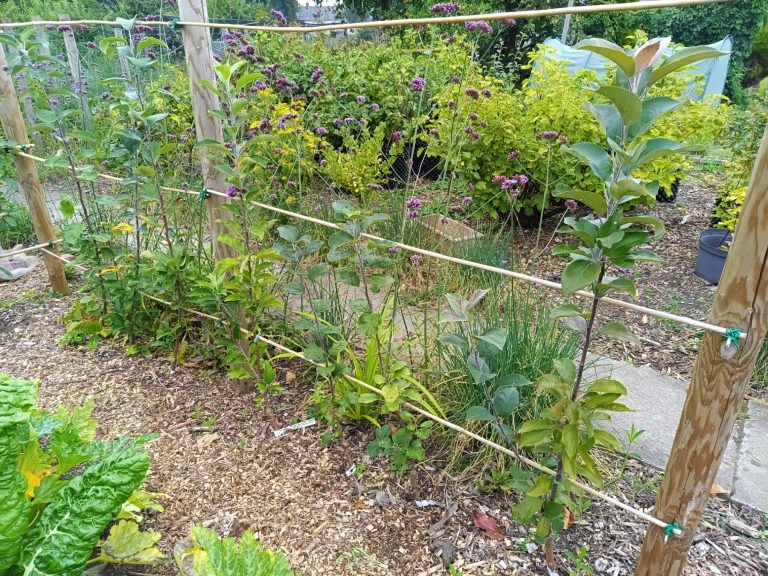
On the left-hand side of the picture below is a (just out of shot) bush ‘Herefordshire Russet’, and a small standard ‘Norfolk Beefing’. On the right hand side is a bush ‘Devonshire Quarrenden’ (probably), and an undecided, but probably short standard, ‘Withington Welter’. And in the centre is a ‘Bramley’s Seedling’ – a.k.a. “Bramley”, the ubiquitous supermarket cooking apple – that’s raising all sorts of tricky questions, training-wise.

The ‘Herefordshire’ and the ‘Devonshire’ are both grafted to dwarfing M9 rootstock and have formed quite neat, small trees, which have fruited well for the past couple of years, so I’m reasonably happy with both of them.
The ‘Beefing’ and the ‘Welter’ are currently growing in air-pots, because they’re quite vigorous varieties that were grafted to semi-standard MM106 rootstock, so if they were growing in the ground they’d be about 3m tall and a similar breadth by now. The air-pots are helping to restrain their natural vigour, but they do make it difficult – in the absence of an automatic fertigation system, and/or unlimited free time – to get enough water and nutrient into the trees over the summer.1I’m thinking of re-grafting them both next year to M9 and re-planting them in the same spaces, if they produce decent scion wood this year. But that may decision is dependent on how the fifth tree in the group continues to grow and develop, and whether it proves feasible to train these vigorous trees to a deliberately restricted form.
The ‘Bramley’s Seedling’ is already grafted onto a dwarfing M9 rootstock; an experiment, of sorts, to see how easy it is to restrain and train this notoriously vigorous, triploid variety to a non-standard, non-bush form. A few UK fruit nurseries seem happy to sell ‘Bramley’s Seedling’ trees on M9, and some of them do mention that their M9 Bramleys are suitable for cordon-training, so I’m very interested to find out to what degree he dwarfing rootstock is able to rein in the Bramley’s natural exuberance, and whether it provides enough restraint to allow for – in this case – tall-spindle training, without the tree just re-growing beyond reasonable control every season.
I’m also interested in whether this Bramley can still produce a decent harvest of apples, given another of its well-known character traits. The thing is, ‘Bramley’s Seedling’ is known to be a “tip-bearer”, which is usually understood to mean that the tree’s flowers tend to form at the ends of last year’s new-grown stems. In the photos below you can indeed see fruiting bud clusters that have formed at the end of fairly long, new stems2I have a few thoughts on what’s actually going on when this occurs, which I’ll save for another blog post.. Here’s an example of one such fruit bud cluster growing at the tip of one of those longer stems:

This particular growth pattern leaves me with a bit of a conundrum. If I want to train this particular ‘Bramley’s Seedling’ – and, potentially a re-grafted ‘Norfolk Beefing’ and ‘Withington Welter’, plus assorted vigorous / triploid varieties that I’ve planted in another row on the other side of the plot’s central path – to a tall-spindle, or vertical cordon form, then I’ll need to remove any new growth that’s protruding from the main trunk of the tree, cutting side-shoots back to around 10cm or so, depending on the placement of buds, and bearing in mind that I’ll always want to prune back to a well-placed bud that’s likely to grow in an appropriate direction. That’s will mean that every year I’ll be removing all of those long stems with all those fruiting bud clusters at their tips, which will, of course, mean losing the potential fruit as well.
Going back to the tree in question, as you can see from these pictures3Apologies for the poor focus. I was hoping that my new phone’s camera would be better at picking out foreground detail from background noise and clutter, but apparently I’m asking too much. Either that or I’ve not found the right setting yet. Top phone photography tips gratefully received via the comments, if you have a sure-fire way of forcing a foreground focus. of the upper and lower sections of the tree, there’s quite a lot of that long, strong growth to remove if I am going to keep it to a compact, tall-spindle form, and quite a lot of fruiting buds to come off as a result:


Luckily though, as the more eagle-eyed amongst you will surely have noticed, ‘Bramley’s Seedling’ is actually only a partial tip-bearer, because it is also capable of producing fruiting buds on much shorter stems:


This is exactly the sort of behaviour that I want to encourage: the production of, after thinning, a single apple on a strong, stocky, short stem that has a good chance of ripening. And as the apple ripens over the course of the season, the part of the stem to which it is attached will develop into a bourse shoot, or knob. This bourse shoot will often then be the source of one or more new fruit buds and/or stems that carry the potential fruit buds that will hopefully develop into apples the following year.
I’m a little hazy, so I need to refresh my memory of which types of shoots – the shorter “dards”, or the longer “brindilles” – tend to produce the most fruit buds, so I won’t go into the specifics here. But the question is: will ‘Bramley’s Seedling’ be likely to form new short stems, which will go on to produce apples and new bourse shoots, and in time create the ideal “bourse on bourse” fruiting spur network that you really want to see on a cordon or spindle tree; or will it be more likely to form longer stems with fruiting bud clusters at their very ends – a reversion to that partial tip-bearing behaviour – that will need to be removed.
My prediction is that longer stems are more likely to form than shorter ones. Again, my apologies for the poorly focused pic below, but hopefully you can still see that the test tree has developed several long stems, with bright green fruit bud clusters at the tips, which have grown out from the short stems topped with bourse shoots that carried the previous year’s apples:

Again, if the tree does produce more longer stems, then I’ll have to trim them back to their point-of-origin at the bourse next year, which will mean sacrificing that year’s tip-borne fruit buds, in the hope of a fruit bud or shorter stem developing from the bourse the following year. I’ll just have to cross my fingers and waiting to see what happens.
In the meantime, I’ll be pruning back all the longer shoots that my tree produced last year – especially the ones at the base of the tree, before they develop into scaffold branches – and of course I’ll be leaving the shorter fruiting spurs to hopefully produce apples and bourse shoots later this year.
It sounds a bit brutal, I know, and I really will have to be determined enough to trim off those fruit buds every year. But if the hard-pruning works, then it will be worth the effort to have a strong, productive ‘Bramley’s Seedling’ tree growing at a nicely manageable size in a few years’ time. I’ll hopefully be able to post future updates as the tree develops.
How about you? Have you tried to restrict a vigorous variety by grafting it to dwarfing rootstock? What pruning regime do you apply? And what results have you seen? Do let me know, via the comments.
Footnotes
- 1I’m thinking of re-grafting them both next year to M9 and re-planting them in the same spaces, if they produce decent scion wood this year. But that may decision is dependent on how the fifth tree in the group continues to grow and develop, and whether it proves feasible to train these vigorous trees to a deliberately restricted form. ↩︎
- 2I have a few thoughts on what’s actually going on when this occurs, which I’ll save for another blog post. ↩︎
- 3Apologies for the poor focus. I was hoping that my new phone’s camera would be better at picking out foreground detail from background noise and clutter, but apparently I’m asking too much. Either that or I’ve not found the right setting yet. Top phone photography tips gratefully received via the comments, if you have a sure-fire way of forcing a foreground focus. ↩︎


An interesting experiment! Another potential problem is that Bramley can get bitter pit, which can be exacerbated by hard winter pruning. I have a large tree which I am reasonable sure is a Bramley. Last year I sprayed a couple of times with calcium chloride and had hardly any bitter pit, but it could also be down to the weather. (Still lots damaged by maggots…)
I have read that after a few years of behaving well, a Bramley can overpower the influence of a dwarfing rootstock, and set off to do its own thing! I suppose this has something to do with the balance of hormones in the tree.
Hugh Ermen suggested grafting in a slow-growing variety as the leader of a too-vigorous tree. I think the leader has a big influence on the hormones throughout the tree. I suppose this would depend on have a tree shape with one clear leader. I have grafted some slower-growing varieties into the Bramley this spring – we shall see what happens!
Hi Stephen – Bitter pit is an interesting one. The general understanding is that it’s caused by a calcium deficiency, but there’s a really interesting research paper, published in July 2010 – The effect of plant growth regulators on xylem differentiation, water and nutrient transport, and bitter pit susceptibility of apple, Griffith & Einhorn – that suggests the underlying mechanism influencing the prevalence of the condition was due to the balance of auxin and gibberelin plant hormones and the influence that they have on the development of xylem tissues within the fruit that transport water and dissolved minerals, including calcium, to where it’s required for growth and development. Fascinating stuff.
Interesting note re: the Bramley potentially over-powering the rootstock. It wouldn’t surprise me at all if its triploid vigour kicked in and rendered the whole thing unmanageable, so I’ll be interested to see how it goes.
Hugh’s method sounds very interesting as well. Was he referring to using an interstock leader, to attempt to slow the growth of more vigorous branches that were subsequently grafted on?
Thanks for the link on bitter pit.
Hugh Ermen was interested in growing apples on their own roots. He said that many varieties were not too vigorous (similar to mm106), contrary to what is often supposed. However, some varieties were very vigorous.
I had a look for the original article, and it seems is mis-remembered! I thought that he suggested growing the tree to approximately the desired height, then grafting in a slow-growing variety as the leader. I thought this should send its growth-reducing hormones down into the rest of the tree. He doesn’t exactly say this! He actually says:
“There are many basic techniques from planting to pruning which can be used to help control vigour, with cropping being the best control. For the newcomer to own root trees, I suggest starting with spur types and heavy cropping diploids. For the experienced person with enough space, the triploid varieties will not present a problem and you can always graft a fertile pollinator in the tree for the leader!”
He did also suggest a “tripod tree” in this scenario, which is interesting. See: https://elizapples.com/2016/03/27/hugh-ermen-own-roots-experimenter/
Hi Stephen – I heard a talk about growing apples on their own roots at the Fruit Moot in Sheffield earlier this year, and Hugh Ermen’s work was a central reference-point. A couple of growers are running a few small-scale experiments to see if they can replicate Hugh’s results, and assess the vigour of a few burr-propagated varieties. Very interesting stuff. Although I’m far too short on growing-space to grow anything other than cordons myself. But maybe one day, who knows?