
The Latest Part of the ‘Beefing’ Apples Story is Now Live
Well, so, it’s taken me a little longer than I anticipated1About 14 months longer…, but the latest part of the ‘Beefing’ Apples Story has finally(!) been posted. This latest instalment has taken me quite a while to put together because it turned out to be so much more intriguingly complex than I ever thought it would be, back when I first started looking into this chapter of the ‘Beefing’ group of apples.
In chapter two, part four – Dr Hogg, Dr Bull and the Origins of ‘Herefordshire Beefing’ – I set out to explore what I thought would be the relatively simple story of the discovery – or was it the re-discovery? – of ‘Herefordshire Beefing’ by Dr Robert Hogg and Dr Henry Graves Bull, at a meeting of the Woolhope Naturalists Society in 1876.
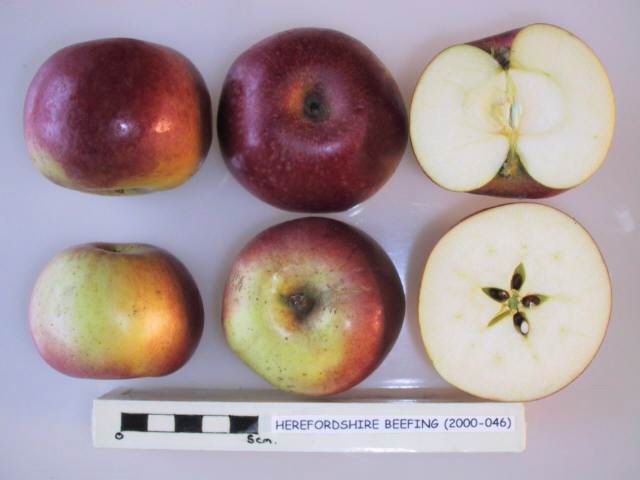
I honestly thought it would be a simple case of compiling the known facts and rattling off the narrative. Except, once I’d found a couple of loose threads in the story to tug on – why are there a few key differences between Bull’s and Hogg’s description and back story of ‘Herefordshire Beefing’ in The Herefordshire Pomona and The Fruit Manual 5th edition, respectively? And why did Hogg decide to add a couple of extra details to his own account, one of which makes no sense whatsoever? – I found myself disappearing down a rabbit-hole of research, speculation, consolidation and, with any luck, some sort of sensible conclusion at the end of it all.
The result is, I think, a very human story, involving several of the leading pomologists of the day, and a nursery company with an eye for an apple-shaped opportunity. I enjoyed researching it and writing it and if, like me, the idea of a deep-dive into the back-story of an obscure apple variety appeals to you, then I think you will too.
I hope you can find the time to read this latest long-read instalment of the ‘Beefing’ Apples Story. If you do, and if you have any follow-up questions, or if you think my conclusions are way off the mark and I’ve missed something glaringly obvious, then please do leave a comment at the end of the article. Or you can send me an email if you prefer, of course.
Next up will be Chapter Three: the story the ‘Beefing’ apples in the first half of the nineteenth century. I’ve learned my lesson, so I’m not going to make any promises as to how soon it will appear. I have written most of it up already, so I do just have the editing to finish off though, so hopefully… Anyhow, watch this space for further updates, or better yet sign up for my email list to receive a notification when it goes live.
Footnotes
- 1About 14 months longer… ↩︎



Thanks for that. I grafted the scions you gave me into a Striped Biffin, no show yet which is anoying and odd cos I grafted a Norfolk Biffin into a root stock and it is showing and looks like it’s taken. Still I will wait and see. I also grafted a “Biffin John” I picked up at the twig swap into the Striped, no show yet. More waiting to do.
Hi George – I checked when I was down the allotment this morning, and my newly-grafted trees have only just started to show signs of bud-break. I think maybe the low temperatures we’ve had lately have held them back a bit.
“Biffin John” is interesting. Not a name-variant I’ve come across, off the top of my head. I’ll have to look into that one…