
The Twelve Historical Fruit Recipes of Christmas
“Now grocer’s trade is in request,
For plums and spices of the best.
Good cheer doth with this month agree,
And dainty chaps must sweetned be.
Mirth and gladness doth abound,
And strong beer in each house is found.
Minc’d pies, roast beef, with other cheer,
And feasting doth conclude the year.”
Anon, from Poor Robin, an Almanack After a New Fashion (1677)
Tis the Season! Which is why, for the past couple of weeks, I’ve been posting a selection of suitably seasonal fruit-based recipes that wouldn’t be at all out of place on your Christmas dinner table, if you fancied trying something a little different this year.
Now that Christmas is very nearly upon us, and by way of an end-of-year sign-off post, I thought it would be a great idea to put together a not in any way highly contrived round-up of these recent posts, along with just enough of the Yuletide-appropriate historical fruit recipes that I’ve posted in recent holiday seasons to make up a round dozen.
Hence and therefore for your consideration, delectation and, I would hope, inevitable salivation, I give you…
The Twelve Historical Fruit Recipes of Christmas!
Ahem. ♫♫ On the first day of Christmas, my true love cooked for me… ♫♫
Yeah, actually, you know what, that’s cheesy even for me and is going to get old pretty quickly. So instead of doing the whole song thing, I think I’ll just run through this year’s selection1There may be another selection in years to come, if I can find twelve more Christmas fruit recipes to post… no promises, but never say never, eh? of recipes in a sort of vague menu-order.
So let’s start with a traditional Christmas Day starter, in the form of:
1. Elizabeth Moxon’s Plumb Porridge (1764)
A mixture of dried fruit, spices, and wine, usually thickened with bread or wheat flour, and sometimes with added beef shank or venison and meat broth, plum porridge was served up on Christmas Day for centuries, often in parts of the country where the tradition was for the local squire to throw a bit of a shin-dig for his tenants and workers.
It’s a seasonal version of a hasty pudding, or maybe frumety, that would have been easy to make in bulk and I rather suspect it would have had the benefit of filling people up quite nicely, before the choicer dishes were brought out2Or is that just me being un-seasonally cynical? It is, isn’t it? I promise not to do it again..
If you’d like to make a beefy, fruity Plumb Porridge of your very own, then Elizabeth Moxon’s 1764 recipe has all the details.
Onwards – assuming, of course, you’ve not eaten your fill already – to the main course! Which, traditionally, would either have been roast beef, for those as could afford it, or roast goose, for the less well off. Either way, you’re going to need a little something to go with those platters of grease-soaked meat that’s going to cut through all that delicious, delicious fat, and that’s where these next few fruity dishes come into their own.
2. Gertrude Mackay’s Stuffed Apples to Serve With a Roast (1913)
What could be finer that a roasted apple, stuffed with chestnuts and redcurrant jelly? The ideal accompaniment to roast meat of all sorts, with those tart, fruity apple flavours complementing all that rich meaty goodness to perfection.
Gertrude’s 1913 recipe has all the info you need to make up this fruity side-dish.
Or, if you’d prefer something a little saucier..?
3. Gertrude Mackay’s Apple Ginger (1913)
Not just apple sauce, not even an apple and ginger sauce, but more a slow-cooked, condensed, flavour-packed concoction of apples, ginger and lemon.
If you did take it all the way to the end of Gertrude’s 4-hour cooking process, I reckon you would probably end up with something closer in consistency to quince- or medlar-cheese. A definite winner with your Christmas goose dinner.
And then, if you’d like a between-courses palate cleanser, how about this?
4. Gertrude Mackay’s Sweet Cider Frappe (1913)
Once again, Gertrude’s recipe is simplicity itself: it’s just sweet cider – which could either refer to apple juice, or a cider that’s a bit on the sweet side – frozen to a frappe / frappé / sherbet / sorbet consistency.
Refreshing, reinvigorating and, if enjoyed after the main course is done, setting you up for one (or more!) of these fruity pudding / dessert options.
Starting with something that’s light on the palate and easy to make:
5. Nellie Willey’s Apple Snow (1887)
A fluffy blend of apple purée and egg white, whipped to within an inch of its life, and then topped with a lemon-flavoured, boiled milk custard? Yes, please.
If this quick and easy bowl of floof sounds like your sort of thing as well, then Nellie’s 1887 recipe has all the details you need.
But if you’re feeling a little more adventurous, then how about turning your hand to…
6. Mrs Wigley’s Apple Snowballs (1877)
These boiled, rice-wrapped apples sound like a bit of a show-stopper to me, but I think making them would definitely be a challenge if you’re not au-fait with cheesecloths and boiling pans.
If you feel like impressing and want to give them a go, Mrs Wigley’s 1877 recipe has all the information you need. Good luck!
Or, if you fancy something rice-based, but nowhere near as fiddly, there’s always…
7. Gertrude Mackay’s Apple Christmas Pudding (1913)
Full disclosure: I don’t think this apple-infused rice pudding sounds at all Christmassy, but it does sound like a rather delicious alternative to the traditional fruity stodge, if the latter isn’t your sort of thing.
Gertrude’s 1913 recipe will guide you through the quick and easy process.
Or, if you prefer to keep it about as Yuletide-y as it gets, how’s about:
8. A Traditional Apple Florentine (c. 1832)
Not just any old apple pie, the Christmas “Florentine” was baked in a large, pewter dish, and just before serving, the top crust was lifted and cut into wedges that were re-inserted into the filling, before liberal lashings of hot, spiced ale were poured in.
Not so much a recipe as a description of the dish that was sent in to William Hone’s Year Book of Daily Recreation and Information by one E. H. B. in 1832, but it should be easy enough to recreate, if you know your way around an apple pie, and you’re looking for that “wow!” factor.
Or you could keep it a bit simpler, with an equally traditional, but much more manageable pastry confection, such as:
9. Charles Carter’s Minc’d Pyes (1732)
What could be more Christmassy than a mince pie? And what could be more traditional than a mince pie made with some sort of minced meat?
In Charles Carter’s 1732 recipe he recommends Neat’s (Cow’s or Calf’s) tongue and plenty of beef suet, as well as all the usual fruit, spices and wine. But you could use lamb, or venison, or beef, or whatever takes your fancy.
Go on, give a proper, meaty mince pie a go! Dr. Neil Buttery of the British Food History podcast says they’re amazing, and who are we to argue?
Although you might want a drink on hand, either to wash your minc’d pye down, or to toast your roaring success. In which case, how do you like the sound of…
10. Jerry Thomas’s Bishop a la Prusse (1862)
A ‘bishop’ – or a ‘smoking bishop’, to give it the Dickens-inspired, modern take on the drink’s name – is made from heated wine with the juice of roasted oranges added in for a citrusy zing.
‘Bishop’ shares its ancestry with Glühwein, and is similar to, but not as spicy as mulled wine, although of course you could make yourself a “spicy smoking bishop” if you felt the urge, and who would blame you?
To stick to the original, London method (as opposed to the Oxford method, which calls for lemons instead of oranges), you just have to follow Jerry’s 1862 recipe.
Speaking of mulled drinks, if wine isn’t your thing, but a blend of ale and roasted apples definitely sounds like it would be, then you can’t go far wrong with:
11. Max Miller’s Lamb’s Wool (2022)
This hugely traditional Christmas drink goes back centuries, and frequently featured in Wassailing celebrations, either the version that saw the local folks going around their village, singing for their refreshment, or the one that involved the blessing of the apple trees in the orchard.
Whatever your intention, Max Miller’s History of Lamb’s Wool on his Tasting History YouTube channel will fill you in on how to go about making up a big batch for you and your friends to share and enjoy.
If you’ve not yet indulged to your utmost limit, and think you could perhaps find room for one more traditional treat, I can heartily recommend something that was a favourite of the Victorian Christmas, then fell out of favour, and is long past due for a revival. By which, of course, I mean…
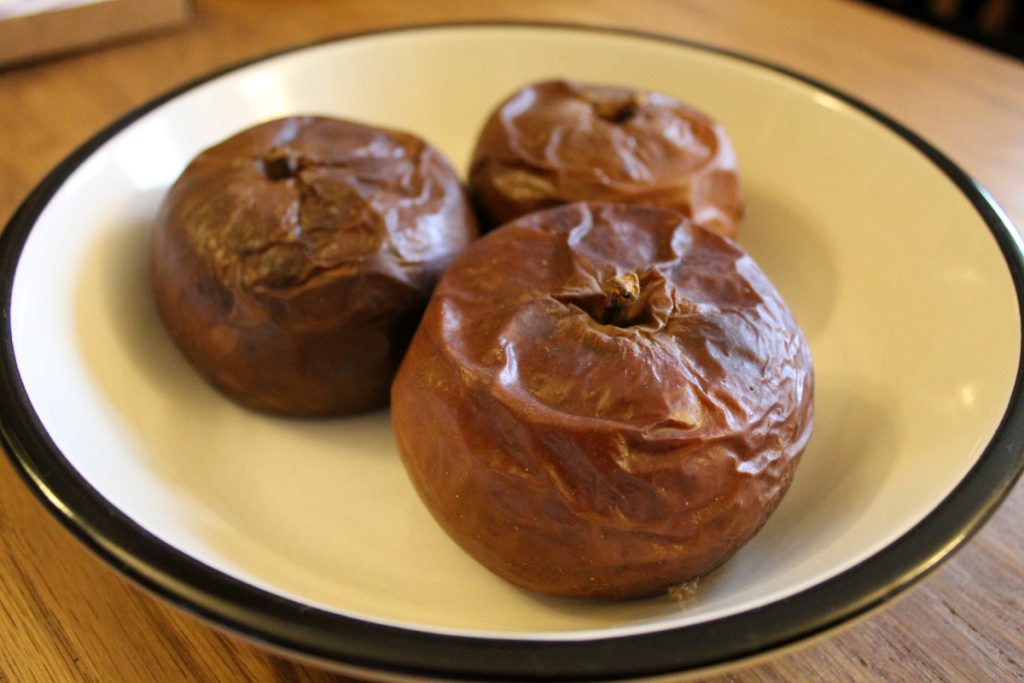
12. Norfolk Biffins! (2024)
What could be better to round off a big, delicious meal, than an old-fashioned dessert course of nuts and fruit? Especially if the fruit part of the dessert came in the form of a slow-dried, compressed, intensely-flavoured Norfolk Biffin.
I’ve been researching the history of these sweetmeat treats, which were mentioned in Dickens’ A Christmas Carol and were hugely popular for most of the nineteenth century, and I had a go at making my own Norfolk Biffins last year. The results weren’t perfect, but it was an encouraging first attempt and the results were very, very tasty indeed.
Highly recommended, and the perfect way to finish off your Christmas dinner.
There you have it! My seasonal selection of fruity recipes from the archives. For more seasonal, historical recipe inspiration, pick up a copy of Glyn Hughes’ The Lost Feast of Christmas (2016) and Annie Gray’s At Christmas We Feast (2022) and see what else our antecedents and ancestors ate to celebrate the season.
In the meantime, please do let me know what fruity favourites you like to enjoy at this time of year. Baked apples filled with mincemeat? Christmas pud à l’orange?3Wasn’t that one of Heston Blumenthal’s inventions? A truly knock-out fruit punch? Something equally delicious? Do please let me know, via the comments.
Just before I go, I’ll be taking a bit of a break for the next week or two to enjoy my own Yuletide celebrations, and I’d like to take this opportunity to wish all the regular readers and occasional visitors to Orchard Notes a very Happy Christmas and a great start to the new year. See you all in 2026!
Footnotes
- 1There may be another selection in years to come, if I can find twelve more Christmas fruit recipes to post… no promises, but never say never, eh? ↩︎
- 2Or is that just me being un-seasonally cynical? It is, isn’t it? I promise not to do it again. ↩︎
- 3Wasn’t that one of Heston Blumenthal’s inventions? ↩︎


Thanks for that. It reminds me if anyone has Norfolk biffin graft wood I would like a couple of bits
TIA
Hi George – I’ll check my ‘Norfolk Beefing’ trees for possible scion material and drop you a line if it looks like I can send some.