
Fruit Harvest Highlights – Summer 2025 Edition
Wow. What an absolutely amazing year we’ve had for fruit here in the U.K.
A warm, dry spring was key to this year’s success, with a welcome burst of good, albeit slightly unseasonal, weather from March, through April and on into May. As a result, legions of winged pollinators were out in force, and with no late frosts to kill off the fruit blossom there was plenty of flower nectar for our assorted insect friends to feast on. That of course meant that they spread pollen around with great gusto, leading to an incredibly high rate of pollination and fruit-set.
What’s more, these perfect spring conditions came on the back of a couple of relatively poor blossom seasons in 2023 and 2024, which resulted in somewhat subdued harvests, particularly of soft fruit and early-blooming trees like peach, nectarine, apricot, plum, cherry and pear. Rested and re-invigorated by the spring sunshine, these bushes and trees all burst forth with an abundance of blossom and were pollinated to excess.

I remember looking up at the various fruit trees at Quarry Bank back in May and realising that I would need to spend weeks thinning thousands of fruitlets in order to keep the fruit-load to a manageable level. Reader I did not end up spending weeks or even days on end thinning fruitlets – there’s always too much to do in a busy public garden in late spring and early summer, and always too few hours in the working day – and many a branch ended up groaning, and in one or two cases snapping, under the great weight of developing apples.
In the end there was so much fruit that our losses this year – to weather-induced fruit drop, bird- and insect-damage, brown rot, all the usual culprits – were huge, with many a a barrow of too-spoiled fruit carted to the compost heap on a daily basis. But even those hundreds and hundreds of damaged fruits – apples, pears, peaches, apricots, plums, figs and more – barely seemed to dent the remaining load on the trees and we were able to put piles of decent windfalls out on the produce stand for visitors to help themselves to1Ideally in return for a generous donation to garden funds, thank you so much to everyone who put a few coins in our collections tub. even before we started on the actual harvesting.
Speaking of which, our actual pickings were even more immense. We harvested many hundreds of apples in little under a week for our Apple Day in September, and that was just the peak of the productivity, the tip of a fruity bell curve that started back in late June with apricots and is still trailing off even now, in mid-November, with a few late-ripening apples2Most of the varieties that have been planted at Quarry Bank in past years are early or mid-season ripeners, with the majority peaking in September and early October. We don’t have many long-keepers, alas. still hanging on the now-leafless trees.

We had a really good year down on our allotment as well, with our more mature cordon apple trees producing plenty of large, lovely fruits – they’re much easier to thin when they’re only five or six feet high, so each individual apple can have more room to grow and develop to its full potential – and fruit bushes which had been hit by hard frosts and too much cold, wet weather last year responding with a bumper crop.
In fact, there has been so much fabulous fruit to tell you about that I’ve decided to split this year’s Harvest Highlights into two posts. This one covers everything that I was picking up to the end of August, and a follow-up, hopefully before too long, will reveal the full bounty of our autumn pickings.
Enjoy!
Stone Fruits
I don’t have any stone fruit trees on my allotment just yet, apart from the yellow plum that was planted at the back of our plot by an adjoining plot holder a few years back3They’ve long since moved-on, and so I’ve adopted the tree.. But at Quarry Bank we have a few members of the Prunus genus growing against in the walled garden. Only the apricot and the cherries gave any fruit last year, but this year all but one of them were much more productive and we all – colleagues, visitors, wildlife – enjoyed the bounteous harvest that started in late June and ran through to early September.
Apricot, Peach, Nectarine
Although our apricot did reasonably well even in last year’s sub-optimal conditions, my longer-serving colleagues have informed me that this is the first year that they can remember seeing a good crop of both peaches and nectarines. All three trees are growing against a south-facing, sun-trap section of wall and they absolutely thrived in this year’s warm, dry spring and summer.
Apricot ‘Moorpark’
This tree was absolutely laden with bright, golden fruits that ripened to a warm, blushing, pinkish-red.


Peach ‘Rochester’
This summer I learned that there’s nothing quite like the taste – and the juice! – of a sun-warmed peach, picked straight off the tree and eaten a few minutes later. Gorgeous.


Nectarine ‘Lord Napier’
Alas, no photos of this one. Although the crop looked promising enough in late spring, by the time the fruits were approaching their ripening season they’d been hit by a couple of late summer heatwaves, and most of them dropped before they were edible. There’s always next year though, eh?
Gages
My Quarry Bank colleagues have all discovered gages in a big way this year. We have three gage trees: an unknown sort (first photo, below) that’s listed in the records as ‘Victoria’, but definitely isn’t, an early-ripening ‘Oullin’s Gage’ (next two photos), and a ‘Golden Transparent’. At last, I think that’s right, but as I say, the records are a little confused. It’ll do for now, they’re all delicious, and that’s what counts.
Gage (Unknown Variety, possibly ‘Green Gage’)

Gage ‘Oullin’s Gage’


Gage ‘Golden Transparent’

Damsons
We have several damson trees in various locations at Quarry Bank – varieties mostly unknown, but probably the standard ‘Shropshire Prune’ – the two largest of which produced thousands of fruits this year. We did our best, but couldn’t possibly harvest them all, mainly because the trees are so tall the best fruits were always just out of reach, even with old “gibbon-arms” here – a nickname bestowed upon me by my old boss and great friend Jo Green at Ordall Hall – up on our tallest tripod ladder. But we still managed to bring in a few dozen kilos, and they were tasty straight off the tree, too.
Damson ‘Shropshire Prune’ (probably)

Plums
Sadly, the four plum trees in the Apprentice House orchard at Quarry Bank aren’t in great condition, and didn’t fruit at all well this year. Again, blossom was good, but as the fruitlets developed most of them shrivelled and died before ever getting anywhere near maturity. They weren’t quite bad enough for me to suspect a Pocket Plum infection, but I do think they suffer from being over-shadowed by some very tall woodland trees, and light-starved plums are not happy plums.
In contrast, the yellow plum at the back of our allotment – variety unknown, but various attempts to crowd-source an identification have led to a tentative i.d. of the famous Pershore culinary plum ‘Yellow Egg‘ – had a typically good year, and I was able to pick and cook up a fair few kilos of these dollops of pure sunshine, for jam and for freezing.
Plum ‘Yellow Egg’ (probably)

Cherries
We have three ‘Morello’ cherry trees growing against a north-facing wall at Quarry Bank. They don’t get much sunlight, just enough to set a small crop each year, which the birds inevitably devour just as soon as the fruits show more than a hint of red. We can’t really net the trees, for public safety reasons, so we just have to enjoy the blossom in spring, then shrug and accept the annual disappearance of the fruits in summer.
I snapped this pic just before the key moment, just to prove that we do actually get a few cherries, temporarily…
Cherry ‘Morello’

Soft Fruits
A bit of a mixed set of results here. At work we had strawberries coming out of out ears, a few gooseberries and red currants, plenty of white currants and black currants and then lots of raspberries later in the season. Down at the plot the white currants were all scavenged by the local bird population before we could pick the majority of them4I know, I should invest in a fruit cage, but it’s a big expense just to be able to pick a few more kilos of currants. and the gooseberries didn’t do so well either. But we did pick kilos and kilos of black and red currants, plus a bag of yellow currants and a steady, if moderate supply of strawberries.
Red Currants and Black Currants

I do love the tangy, zingly, sharp hit of red currants, and have discovered that they work very well cooked in porridge when blueberries are out of season.

Black currants likewise, although I tend to bottle these in a light sugar syrup, or stew them with apples for a mid-winter hit of anthocyanin goodness when a supply of good fresh fruit is a bit more scarce.

Yellow Currants
The jury is out on these. Flavour-wise they’re a bit bland, and they’re a fiddly pain in the fingers to process, as I talked about back in August.

Early Apples
The extended warm spell from April to June seemed to bring the early apple varieties forward well ahead of schedule, which meant we were picking August ripeners towards the end of July and some of the September types in mid-August. But then there was a bit of a dull spell towards the end of July that seemed to lessen the acceleration, allowing the late September and October apples to ripen at their usual pace.
Anyhow, here are a few of those early varieties:
Beauty of Bath
A very pretty-looking apple, but not big on flavour. Better this year than last though, so maybe they really do need that early warmth to get past that bland, watery stage.

Apple ‘Devonshire Quarrenden’ (probably)
This tree was ordered and delivered as ‘Cornish Aromatic‘, but the fruit aren’t at all true-to-type, so earlier this year I ran a re-identification and decided it was probably ‘Devonshire Quarrenden’ instead.
The Devonshire is tasty enough, but I think I’d probably prefer the russety, apparently spicy-flavoured Cornish, so I’m hoping to secure a few scions of the latter for grafting next year.

Apple ‘Discovery’
One of my favourite August apples, and it goes without saying that it’s much tastier from your own tree than bought from any supermarket.

Apple ‘Keswick Codlin’
A reliably prolific, early, dual-purpose, sharp-sweet apple that’s excellent if you’re not in the mood for something too sugary, or want to cook up a silky, smooth apple purée.

Apple ‘Irish Peach’
I tried this one for the first time this year and thought it was okay; refreshing, sweet-sharp, but like ‘Beauty of Bath’ not blessed with massive amounts of flavour. They do go soft remarkably quickly once they’re off the tree, so definitely not a keeper.


Apple ‘Red(?) Ellison’s Orange’
We have three trees labelled ‘Ellison’s Orange’ in the database at work, but they all produce apples that seem to be more highly coloured than the reference photos at the National Fruit Collection or FruitID.com, so I suspect they might be the ‘Red Ellison’s Orange’ sport instead.
Whichever version of ‘Ellison’s Orange’ they are, they’re absolutely delicious, with a deep, aniseed-tinged flavour that develops more strongly as the season progresses. Worth keeping on the tree as long as possible, although they hit their peak in mid to late August in our neck of the woods and do tend to drop after that.

Apple ‘Tupp’s Favourite’
This is a rare Welsh variety that I had scions of from Stewart Waine, who in turn had it from the folks at Welsh Mountain Cider. My cordon tree fruited for the first time this year and I was very impressed with the deep, almost cough-sweet herbal flavour of the fruit. Again, not a great keeper, but one to be savoured when it’s at its peak in mid-August.

Apple ‘Tydeman’s Early Worcester’
This is, so far, my absolute favourite early apple, richly flavoured and full of juice, it’s an absolute treat every time. Which is why I now have three cordon trees of this variety on my allotment plot, and wouldn’t object to planting a fourth.
Some of the fruits this year had a red flush beneath the skin that I hadn’t noticed before.


Grapes and Melons
We have two very large glasshouses at Quarry Bank which in their heyday were used to grow grapes and other delicate fruit trees. Today we try to grow grapes in the far half of the vinery, which is heated and closed to visitors over the winter, but despite our best efforts we’ve had limited success for the past two years. We just can’t spend enough time in there adjusting the ventilation and damping down the floors to create the ideal conditions – which, if the old glasshouse fruit growing manuals are to be used as a guide, need to be adjusted on an almost hourly basis depending on temperature fluctuations throughout the day – for grape-growing. As a result, sooner or later, the mildew takes hold, and rot swiftly follows. Which is sadly what happened to most of our crop this year:

Melon ‘Emir F1’
We had a lot more luck with melons though – which m’colleague Cath is in charge of5Yes, we did all the “Cath’s melons” jokes you could think of, and yes, 99% of them came from Cath. and very proud of, and rightly so – and managed to grow a few absolute beauties this year, in the same part of the glasshouse as the grapes:
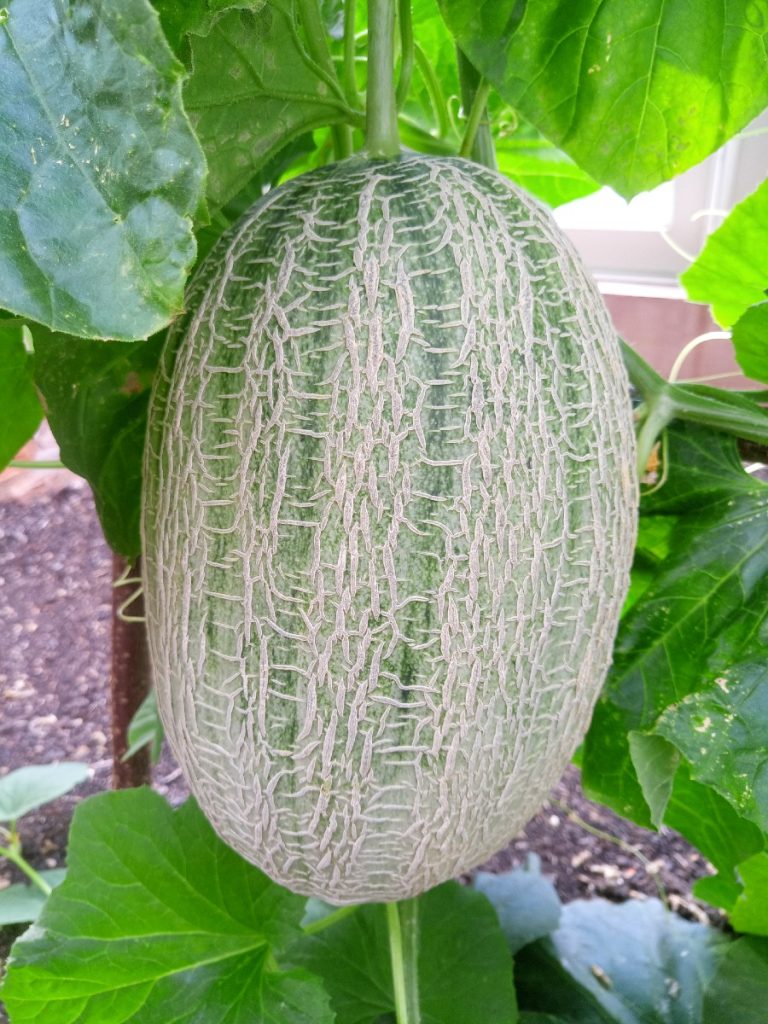
Very tasty they were, too. Well, we had to do a bit of quality control, didn’t we?
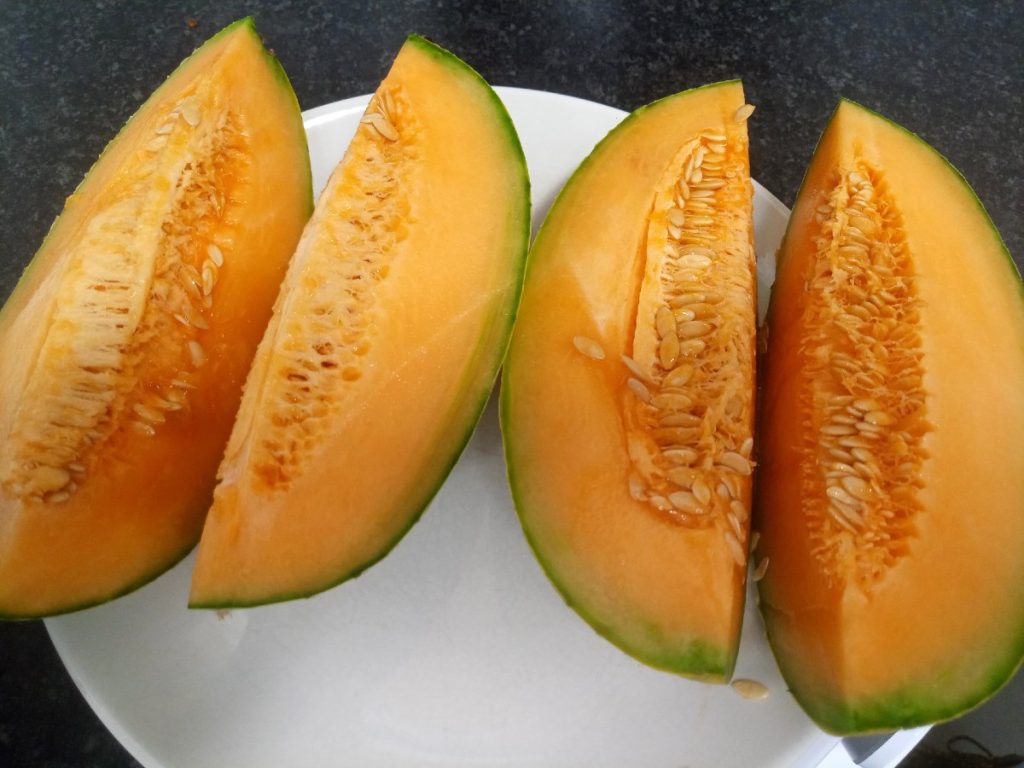
Figs
We grow ‘Brown Turkey’ at Quarry Bank, and I have a much smaller ‘Brown Turkey’ tree in my back garden as well. Oddly, my back garden tree was a lot more productive than the tree at work, but perhaps it’s because it’s growing in a fig pit, to restrict its roots, whereas the tree at work is in relatively open ground, even though it’s growing against a wall, and seems to put a lot of energy into shoots and leaves at the beginning of the season, at the expense of early fruits.
Anyhow, we enjoyed a good few dozen absolutely delicious figs this summer. We mostly ate them fresh from the tree, as we picked and scoffed them too quickly for them to hang around long enough to be turned into fig jam, fig paste or fig chutney. Who knows, maybe we’ll get an even larger crop next year and then we’ll have to find a more creative way to use up the surplus.
Fig ‘Brown Turkey’


Japanese Quince
One other plant that fruited really well this summer was the Japanese quince – a white-flowered specimen of the Chaenomeles x Superba species – in our back garden.
Although the fruits can be cooked into a variant of quince jelly, I just couldn’t find the time this year. Instead they’ve been sitting in a bowl on the kitchen windowsill for a couple of months, gradually shrivelling and shrinking. Every so often I take a deep breath of their rather delightful scent, and just enjoy them for their fragrance.
Chaenomeles x Superba

So, there we go. That’s the 2025 Fruit Harvest, part one. Plenty more to come in part two, once I get around to processing the photos and writing up another post. In the meantime, please do let me know how your own harvest has gone this year. Are you buried under mountains of fabulous fruit? Did your favourites do particularly well? If things weren’t so great, do you have any ideas for changes or improvements that you’re planning to make next year? Do please let me know, via the comments.
Footnotes
- 1Ideally in return for a generous donation to garden funds, thank you so much to everyone who put a few coins in our collections tub. ↩︎
- 2Most of the varieties that have been planted at Quarry Bank in past years are early or mid-season ripeners, with the majority peaking in September and early October. We don’t have many long-keepers, alas. ↩︎
- 3They’ve long since moved-on, and so I’ve adopted the tree. ↩︎
- 4I know, I should invest in a fruit cage, but it’s a big expense just to be able to pick a few more kilos of currants. ↩︎
- 5Yes, we did all the “Cath’s melons” jokes you could think of, and yes, 99% of them came from Cath. ↩︎



Always good to read your observations, such a magnificent harvest this year.
Glad the squirrels allowed you access to your peaches.
Did you find this seasons wasps came in hard and early mid July feasting on early cherries, early plums and apricots but declined once the later plums and early pears were peaking?
Great record of the 2025 season, I’ve still got Apple ‘Leathercoat’ and ‘ Golden Russet ‘ for you.
I still don’t think your yellow plum is the yellow egg/ Pershore plum.
Hi Steve – Great to hear from you as always!
I think the squirrels had enough on their plates with the mast year for oak and beech without having to plague the peaches, although I’m sure they took a few. Not like last year when they stripped the tree at the green-fruit stage though.
Wasps weren’t plentiful in our neck of the woods. I remember seeing a few in mid Summer, yes, but there was so much fruit around at the time they couldn’t really put a dent in the overall total.
Thanks very much for the reminder re: scions. I’d definitely like a bit of both of those, thank you very much!
Remind me, what did you think the yellow plum might be if not Yellow Egg? I’ve had a few conversations about it and can’t remember the details. Time to make a proper note, clearly.
You have a marvellous appreciation of the various fruits.. I am glad the Japanese quince did not get shrugged off. I too love the scent of the fruit and keep them in my kitchen till they dry out. I didn’t get much performance out of the Tydeman’s Early; no redflesh- mostly scabby shrivelled and buggy. It seems to be a biennial tree in my garden. I had a tree that was labelled as Golden Delicious from the clearance box in Tesco but its rich fruit are something between Jonagold and Katie. I have just picked them on the 23rd November. None of the late “keeping” apples seem to be prepared to last-out the long months till the spring.
I am guessing you will be mentioning the medlars in your next post….! I had the Nottingham tree festooned with fruit and have just picked them following the first frost. My crop of Senlac was disappointingly early and shrivelled and rotted rather than bletted. But my bountiful Nottingham crop is now in a cardboard box in a cool place in my outbuilding.
I expect that the nut trees will be mentioned too in your next post…. I have had my best year yet for walnuts and the few that I have already opened are beautiful fresh tasting- unlike last year’s crop that the squirrels ignored because they were so bitter.
Hi Bob – Very good indeed to hear from you as well!
Sorry to hear your Tydeman’s E. W. didn’t perform. Horses for courses, I’m sure. It must really like the sandy soil on our allotment plot – maybe plenty of drainage is the key to getting good results from this one?
I keep meaning to write a ‘Caveat Emptor’ post about supermarket clearance trees, but haven’t managed to get around to it yet. Doesn’t surprise me that the nursery would stick a ‘Golden Delicious’ label on something random, knowing there’s never going to be any comeback on it. I think late-keeping varieties are becoming vanishingly rare, although of course longkeepingapples.com is doing a brilliant job of collecting as many as possible for future reference.
Yes, medlars will be featuring in part two, although we didn’t have a nut harvest this year. The squirrels were definitely all over the hazel trees long before we got a look-in. Very glad to hear you’ve been enjoying some fresh walnuts. I do love the flavours of fresh nuts when I can find them. Green filberts are a particular favourite.
I can give you a more up to date report on my Cornish Aromatic fruit. It may be my soil/aspect/weather/taste but I haven’t bothered to pick them, and think I rarely do. This year, along with the cider varieties, the fruit is small and slow to ripen and are still hanging on the tree, a bit scabby and bird-pooped now. The flavour, even when they were more attractive, was nothing special, and at a time when the apple store is packed with very tasty fruit I’m leaving them to the starlings.
Hi Jean – Thank you very much indeed for the ‘Cornish Aromatic’ update, and I’m sorry to hear it hasn’t had a good year. As you say, there’s not much point to a variety that isn’t performing well when you have plenty of others to enjoy that are.
I’d still quite like to give it a go myself though, if there’s any chance you wouldn’t mind sending me a few scion sticks next Feb or March? Just to see if it’s happier in our neck of the woods, on our sandy soil. I’d be happy to pay the postage, or scion swap for anything I’ve got available, of course.