
A Few Notes on Yellow Currants
We have a small yellow currant (Ribes aureum) bush on our allotment, and this year, along with its red and black currant cousins1Sadly, I’m unable to add white currants to the list, as they were all taken by birds before they were ripe. And our pink currant bushes aren’t fruiting just yet., it has fruited exceedingly well.
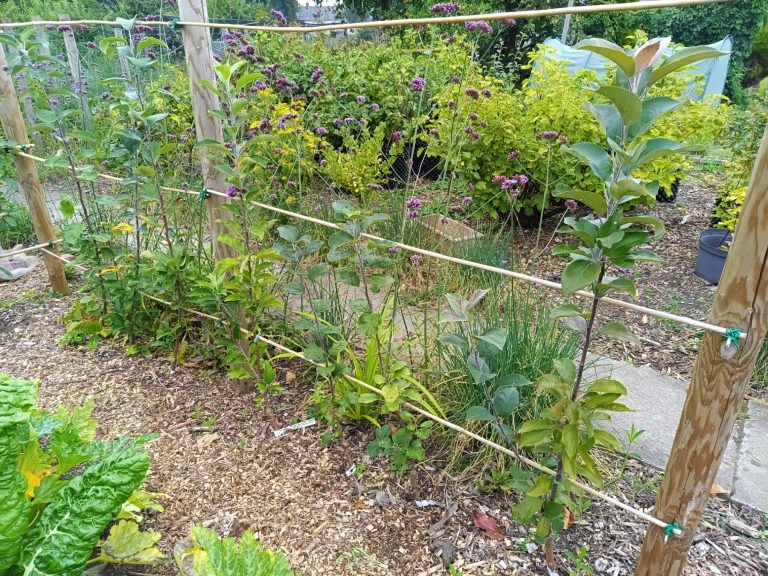
A little too well, perhaps, as the current (pun intended) state of the bush suggests:

I did try to support it with a cane, but the weight of the fruit has dragged the stems right over, so a bit of hard pruning might be required to restore its shape next year.

That didn’t stop us from harvesting a few hundred grams of currants from the plant last week though. At which point I think I discovered why the yellow currant isn’t anywhere near as widely grown as the other members of its extended family.
You see, each berry tends to hang on to the shrivelled remains of the flower that preceded it, leaving a long, tough, distinctly unpalatable, fibrous string. And each of those strings has to be removed, by pinching them off with a thumbnail, before the berries are edible:

Which is, of course, a fiddly job that leaves you a bit thumb-sore after you’ve done a few hundred. And to add to the general frustration, the berries themselves don’t seem to be all that tasty, to my palate at least. They lack the sharpness of red currants, or the zing of black currants, or the mellow sweet-sharpness of white currants. Don’t get me wrong, they’re not particularly unpleasant. They’re okay, but nothing more than that. Honestly though, I don’t think they’re worth the processing time.
Anyhow, I’ve bagged and frozen our yellow currant crop for the time being, and at some point I’ll bottle them in a light sugar syrup, to see if cooking them improves the flavour at all. If not, then I think I’ll be leaving future yellow currant harvests for the birds.
There is still a really good reason to grow yellow currants though, and that’s because in late spring, in a good year, they do this:

I don’t know about you, but I think any plant that puts on an explosion of yellow blossom is worth keeping around, just to cheer you up every time you catch a glimpse of it. And yellow currants must be good for pollinators – looking at the shape of the flowers, maybe long-tongued bees? – because a whole lot of those flowers matured into berries this year.
How about you? Are you a yellow currant grower, or a yellow currant fan? Do you have any top tips for getting the best flavour from the berries? Do please let me know, via the comments.
Footnotes
- 1Sadly, I’m unable to add white currants to the list, as they were all taken by birds before they were ripe. And our pink currant bushes aren’t fruiting just yet. ↩︎


Interesting to see the fruit of your Ribes aureum. I’ve only come across this as the rootstock/stem of standard gooseberries.
I’ve detached the suckers, but to date not had any luck grafting my own standard gooseberries.
Ah, I didn’t know that aureum is used as a rootstock. That’s interesting. I definitely bought mine as a plant in its own right (as it were) rather than it growing from anything else. Mine’s a bit too scrawny to try to graft anything else to it.