
Seeking Information on a ‘Hundred Ha’penny’ Apple
If you happen to read this post, and you happen to have heard of, or even better, have access to any sources of information that mention, an apple variety or cultivar called something along the lines of ‘Hundred Ha’Penny’, then please do let me know, either by leaving a comment below, or by dropping me an email. Here’s why:
Earlier this year my colleague Sophie and I tackled a slightly unusual and, as it turned out, rather intriguing pruning job at Quarry Bank.
We were working on the remains of what used to be of a row of cordon apples trees, originally planted along the base of a fence in the laundry lawn area of the Apprentice House garden. Most of the trees were long gone, except two. One of them had collapsed to the horizontal, but then had re-grown an entire standard-form tree from one vertically-aligned side-shoot. The other had almost completely collapsed and was in pretty bad shape, on the verge of complete die-off, but was just about clinging on.
We assessed the state of these two survivors and decided that the large, re-grown standard could be kept pretty much as it was. We thinned out the top, trimmed the horizontal growth away from the base, and left it to see how it would cope with a near right-angle bend in its trunk. Answer: quite well, as it happens. It seems to have fruited well this year and hasn’t shown any signs of undue strain.
The other tree though, was past saving. Or at least, was past saving in its present form. There was just enough viable regrowth for me to take a few scions, which I grafted earlier this year1Hopefully they’ve survived and taken… I really must double-check next time I’m down the plot., but the rest of the tree was removed to make room for other planting.
But what sort of apple, I hear you ask – and I was certainly wondering this myself – is it that I was trying to save and propagate? Was it a common-enough cultivar, like ‘Cox’s Orange Pippin’, or ‘James Grieve’? Or was it something a little more interesting?
Well, as it happened, there was an old, metal tree tag attached to a branch of the tree. Now, of course, it doesn’t necessarily follow that a tag on a tree has been there since the tree was planted; it could have been moved from another tree at some point, or another plant entirely, so it doesn’t necessarily confirm the name of this particular tree.
But on the other hand, let’s keep it simple for now and say that this probably is a tag that was intended to identify this particular tree. Great! Except: there was just one problem. The tag – pictured at the top of this post – is all-but illegible. Here’s the image again, for your viewing convenience:

The best I could make out at the time was a capital H, maybe an R later on. So I passed it to Sophie, whose eyes are younger and stronger than mine, who took one look and said “Hundred Ha’Penny?” And you know, looking a bit closer at the scratchy lettering on that old tag, I reckon she’s spot-on.
So now we had a name. But was there any corroborating evidence of any such tree being planted here? I did a bit of investigating of the old files on the server at work. It turned out that the records for this particular row of cordon trees are somewhat sketchy, at best. I found a spreadsheet on the server dating to 2012 which suggested the cordon row might originally have comprised a selection along the lines of:
- Adams’ Pearmain
- Ashmead’s Kernel
- Court Pendu Plat
- Duke of Devonshire
- King of the Pippins
- Lady’s Finger of Lancaster
- Lane’s Prince Albert
- Margil
- Orleans Reinette
- Ribston Pippin
No ‘Hundred Ha’Penny’ there. And nothing that the lettering on the tag might feasibly spell out instead. Still, it will be interesting to see if I can identify the apples on the surviving, right-angled standard, and see if any of them match up. But the collapsed tree and the ‘Hundred Ha’Penny’ tag is still a mystery to be puzzled over. The main mystery being that no-one in the history of pomology seems to have mentioned a ‘Hundred Ha’Penny’ apple.
I’ve checked pretty much all of the pomology books and online resources that I have access to – an I have access to quite a few2Print titles by Bultitude, Crawford, Morgan & Richards, Taylor, Rolff, Burford, Hogg, Downing, Barron… you name it, and all the online databases I know of besides. – and none of them mention a ‘Hundred Ha’Penny’. The closest I’ve found is an ‘Old Hundred’ in A. J. Downing’s The Fruits and Fruit Trees of America, but I don’t think that’s a realistic match. And it’s almost impossible to search Google Books for a phrase like ‘Hundred Ha’Penny’ without getting back hundreds of false positives, so that’s a neeedle-in-a-haystack quest that I don’t have the time or inclination to tackle.
There’s always the possibility that it’s a hyper-local variety, perhaps a seedling raised in the North Cheshire area and only ever grown in a very small number of locations in the general environs of the Wilmslow-ish area. On a similar note, we do have two trees of ‘Withington Welter’, a.k.a. ‘Withington Fillbasket’, which is one you won’t find growing in many other locations. But without something to go on, it’s impossible to say for sure.
All of which is why I’m throwing the question out to the good people of the online pomologiverse: have any of you heard of such an apple? I’d really love to hear from anyone who has any solid information, or intriguing clues, or helpful suggestions that might help track down a ‘Hundred Ha’Penny’. You can get in touch by leaving a comment below, or by dropping me an email.
And in the meantime, hopefully those grafts will have taken, and in a couple of years I’ll have a few apples that I’ll be able to run through an identification process, just in case it was one of the trees in that 2012 list all along. Which would just leave the mystery of the all-but-illegible label itself and what it might originally have been attached to…


Did the grafts take?
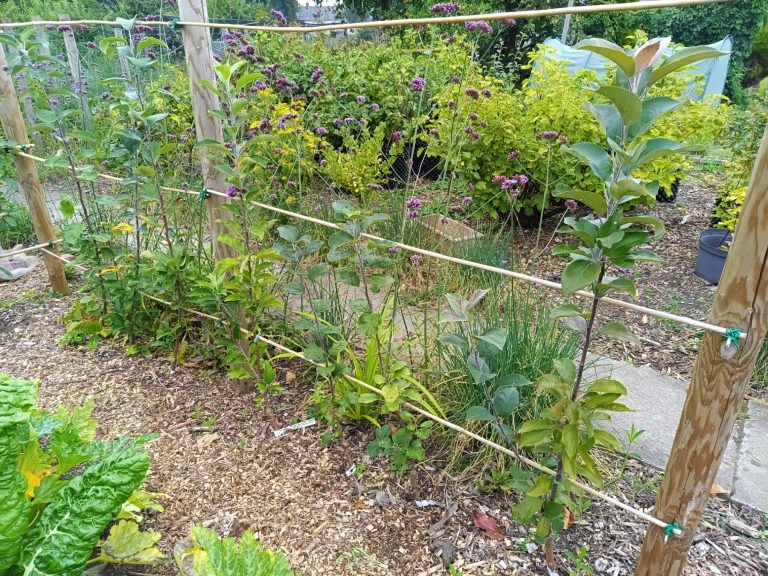
Hello Nicholas – Yes, a couple of the grafts took, and earlier this year I planted out two ‘Hundred Ha’penny (??)’ cordons. One of them was infected by canker, so I had to cut it back quite hard, but the other one seems to be growing quite well. Another year or two and I might have a fruit on it to identify, you never know.