
A Few Notes on Ancient Roman “Apple” Varieties
Every so often I’ll come across the back-story of an apple variety – either online, in print, or in a social-media post – in which the impressive-sounding claim is made that the variety in question dates back to the ancient Roman era.
Here are a couple of examples. First, an apple variety by the name of ‘Decio’. The entry on the National Fruit Collection website says:
“This variety is said to date from the time of Attila (c. 450 CE) and to have been brought to England by Roman general Ezio from Latium, Italy. Fruits have firm, fine flesh with a slightly sweet, slightly subacid flavour.”
You have to admit, that does sound quite ancient, and rather Roman. Other sources tell a similar tale, or add a few details to the above, and I’ll be taking a look at those later on.
There’s also ‘Court Pendu Plat’ and again, according to the N.F.C. database:
“This variety originated in Europe. It was first described in about 1613 but believed to be much older than this.”
Much older, eh? But how much older? Well, one or two sources do hint quite strongly at an ancient Roman origin, as we’ll see.
And isn’t that great? The idea that we could grow and eat a variety of apple that a Roman citizen – or a Senator, or even an Emperor! – might once have been able to enjoy? Very exciting!
I do have to admit though that whenever I see something like that, there’s always a slightly cynical voice in my head, that pipes up and says: “Yeah, but… ancient Roman? Really?“
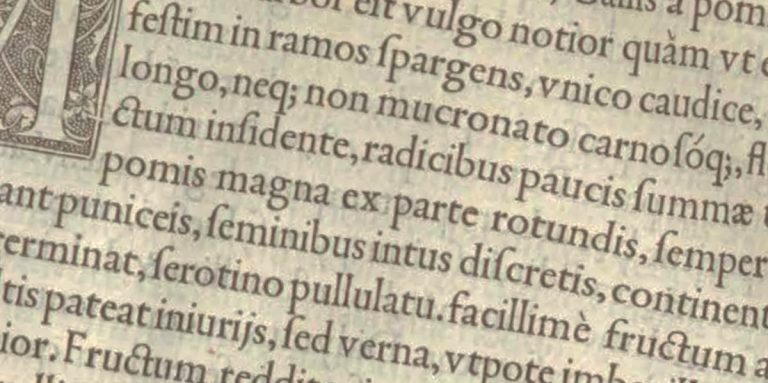
And so, mainly to try to shut that voice up for a while, I thought I’d spend some research and writing time looking into actual ancient Roman sources, to see which apples were actually mentioned, by which ancient Roman writers, and then see if I could work out whether any of those verifiably ancient Roman apple varieties just might still be around today.
I reckoned it would probably take me an hour or three to find something definitive and write up a quick blog post. Instead, I’ve ended up spending the best part of a month’s worth of research and writing time on going back through numerous ancient Roman sources, cross-referencing them with modern translations of the Latin, and diving into as much pomological literature on the subject as I could find. In other words, a research rabbit-hole opened up and I jumped right in.
As a result, I have managed to find out quite a lot of rather interesting detail on the subject, and what I’ve uncovered so far I’ve added to the site as a short series of pages on Ancient Roman Fruit Varieties. The series has “fruit” in the title, rather than just “apple”, because, although at this stage I have only looked into ancient Roman apple varieties in detail, at some point I hope to return to the subject and examine a wider range of Roman-era pome fruits, particularly pears and plums.
Please nota bene: I realise that time and attention are precious resources, so I’ve set up a shortcut to bypass the denser parts of the write-up. If you’re not hugely interested in the detail of the ancient Roman authors and source material, or my analysis of the available evidence as to whether or not ‘Decio’ and ‘Court Pendu Plat’ might be modern day survivors from the ancient Roman era, then please feel free to head straight to the Summary and Conclusions page for a list of ancient Roman apple varieties, and a quick overview of my other findings.
I hope you enjoy the fruits of my research labours. Valeo!


Fascinating! When do you find time for all this research, given that you have a full-time job?!
You mention problems accessing D.K. White’s book on Roman Farming. It is available for free on https://archive.org/ – all you have to do is to sign up and then ‘borrow’ the book. Hope that helps.
Hi Martin – Thank you very much. I only work part-time, as it happens, so that helps with freeing up research time. Also: no kids. Oh, and I get up a lot earlier than my beloved on a weekend… 😀
Thank you very much indeed for the Archive.org tip! I’d been using the site solidly for a month to access all those Latin translations, but it hadn’t occurred to me to check out a more recent title. Now then, let’s have a look and see what Professor had to say about Roman apples… ooh, interesting. Might be a bit of minor editing required…
I found a community orchard earlier this year and the tag on one of the trees says it is a Court Pendu Plat. Someone had got to the orchard harvest before me but because it is also described as a ‘late fruiting apple’ (they reckon from the C.12th?) I managed to nab one which had grown when the scrumpers had gone home, ha! So it was the first Weird Apple I ate this year, therefore very exciting to read about here. Hurrah!
I don’t think I’ve had a ‘Court Pendu Plat’ myself yet, although there’s a new-ish tree in one of the orchards at work, so I’m hopeful I might get to try one in a year or two. I’ve got another article in the works that takes a deep-dive into the origins of the ‘Court Pendu’ group of apples – once upon a time there were a couple of dozen related varieties – but it might be a while before I get that polished up. Watch this space…
This was such a fascinating read! I never realized that the ‘apples’ mentioned in ancient Roman texts might have referred to a variety of different fruits. It’s incredible how food terminology has evolved over time. I’d love to know more about how these ancient fruits compared in taste and texture to the apples we know today. Were any of these varieties cultivated into modern species? Thanks for sharing such an interesting insight into Roman agriculture!
Thank you Maria, very kind of you to say so. I looked into whether any of the ancient varieties of apple might have survived to the present day in the modern-day survivors section of the write-up. The short answer is: maybe, but it’s very hard to say for sure.