Stepover Apple Tree Update – Spring 2024 Edition
For the past five years I’ve been growing a pair1It used to be a trio, but one of them was far too vigorous a cultivar, on far too vigorous a rootstock, and so it was lifted and donated to a local community orchard last winter. of stepover-trained apple trees on my allotment plot in North Manchester. Contrary to most of the advice given in most of the general gardening guides and fruit tree growing texts, I’ve been pruning them only in winter rather than in summer – see my ‘Stepover Apple Trees, Winter Pruning’ posts for years one, two and three for more detail of the method, if you’re interested – and I’ve been keeping a keen eye on the general health and performance of the trees to see how they’ve been responding.
I’m delighted to say that, despite the wet, largely grey spring that we’ve had so far this year, both trees – a ‘Keswick Codlin’ and a ‘Howgate Wonder’ – appear to be doing very nicely indeed. They both fruited well last year but, due to the early-summer fruitlet-thinning regime that I applied, they weren’t overloaded and so they had plenty of energy and nutrients available to to ripen last year’s fruit and set fruit buds for this year as well.
Here’s how they’re shaping up this year.
Keswick Codlin
At the very start of May the tree was in full bloom, with healthy-looking flower clusters spread out along its length:


Two weeks later, on May 15th, the blossom was over and leaf-growth was in full swing:

Howgate Wonder
A very similar story here, with good, strong-looking flowers forming in early May along the two main branches of the stepover:


Then, a couple of weeks later, the blossom was over, and leaf-growth had kicked up a gear:

Fruit is On the Way
I had a quick check earlier today, and fruit-set was looking good on both trees (pics: ‘Keswick Codlin’, then ‘Howgate Wonder’):


I’ll be rigorously thinning those fruitlets in mid-June, once the trees have had a chance to naturally shed a few, and this year I’ll be leaving a single apple per spur on the ‘Howgate Wonder’, to see if that helps to avoid the minor pest-damage problems that occurred last year, when woodlice burrowed into the stem ends of fruits that had been growing back-to-back on the same spur:

I’ll post another update later in the year, as we get towards harvest season, in which I’ll assess the effects of whatever sort of summer we get this year. Hopefully it won’t be a repeat of last year’s scorching June and soggy, grey July.
How about you? Do you grow fruit trees in trained forms? If so, how do you prune them? And how are they looking so far this year? Do please let me know, via the comments.
Footnotes
- 1It used to be a trio, but one of them was far too vigorous a cultivar, on far too vigorous a rootstock, and so it was lifted and donated to a local community orchard last winter. ↩︎



I’m not familiar with woodlice, but I was mosing the other day on an observations made last growing season (down here in Australia). In our small ‘backyard’ I have 12 ballerina/ step over/ crab apples, and floriferous gardens inc some very long flowerers and good insect magnets. In the front of property, a green windy desert (few things beat a lawn for a biodiversity desert) and I have another 15 apples as well as quince, pears and plums etc, but few flowers. The front trees get absolutely massacred by cherry and pear moth (sawfly larvae) if I don’t make time for drastic intervention. But the back yard trees I ignore and every leaf is perfect. Build it and they will come. I am well impressed, and this very much enforces the imperative to get it together and get more flowers down there.
Thank you, I always enjoying your posts
Hi Amanda – Lovely to hear from you! I think the benefit of additional floral planting has to be the increase in biodiversity, surely? More insect species attracted to an area means more predators who will then hopefully transfer their attentions to the trees and take care of the moths, aphids and other assorted pests? I’ve seen bird-boxes highly recommended by some folks, as the more breeding birds in an area the more larvae are taken to feed growing chicks.
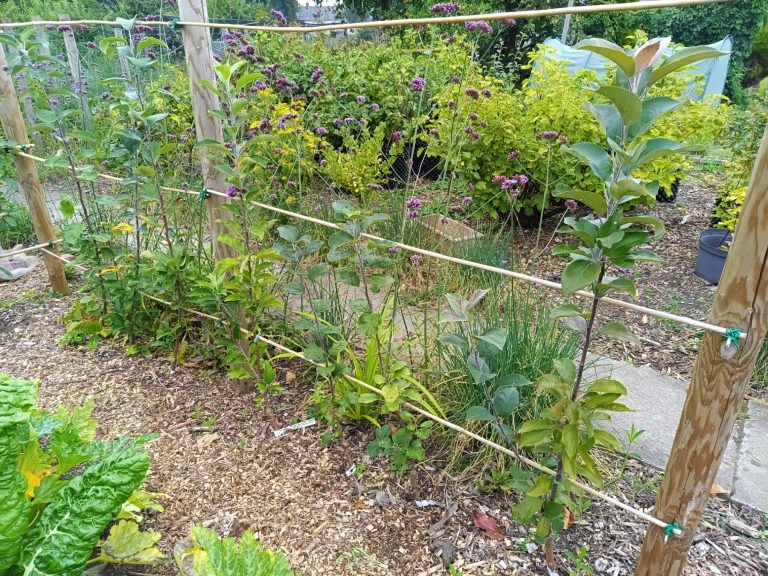
Also noticed the Centaurea montana in your foreground, I have the same planted under my ballerinas, with crimson clover and chives. What a great little pollinator plant! attracts ladybirds, honey bees and native bees here. and yes, I work hard for biodiversity here. Further to my comments above, happily I am getting more flowers into the front lawn desert and seeing some good insect activity in (front) orchard. The bird populations have increased every year since we’ve been here, gratifying, late spring here and so many tiny wrens, we’ve got up bird boxes, some microbat boxes and one big long hollow* which a pair of breeding kookaburras have happily moved in. Bushfires here 12 years ago devastated a massive amount of the states forest and we lost a lot of hollows and habitat. Yes, more complex biodiveristy creates a micro ecosystem that takes care of itself. Such a joy to be a part of it. My apples have now just all finished blooming and fruitlets forming. fun times : ). Once agsin, love your work here, thank you.
Hi Amanda – Yes, we do love the Centaurea, as do the honey bees from the hives at the bottom end of the allotment site. They’re under-planted with a repeat-flowering Geranium as well, and we tend to allow Prunella vulgaris and Myosotis to self-seed around as it sees fit, and we have plenty of chives as well. I’ll be adding some white clover into the mix as well next year, mostly as a green manure for the squash beds, but I’ll scatter some around the apple trees as well. I do need to add more bird-boxes around the plot though. Something to work on. I don’t think we’ll get kookaburras in Manchester though… 😀
I do hope your fruit-set is good this year. It’s always a joy to see blossom and fruitlet photos from Australia and New Zealand, really helps to cheer me through the winter months up here in the northern hemisphere.